On the innovation of mainstream media’s external communication strategy

Absrtact: China International Television (China Global Television Network) (hereinafter referred to as CGTN) is a new flagship of international communication created by CCTV. As a window to show the image of China, CGTN has made a series of new explorations and attempts. Combing CGTN’s innovative practices and exploratory practices in external communication, the current international communication pattern and the current situation of China’s external communication is of great benefit to how to continue to take the road of external communication with China characteristics.

Keywords: CGTN;; China media; External dissemination

Communication power determines influence, and discourse power determines initiative. Looking around the world, China is still facing a severe international communication environment. In 1942, lazarsfeld put forward three "effective conditions" to improve the communication effect in The Effect of Broadcasting on Public Opinion. In 1948, it was transformed into three concepts: monopoly, channel and supplement. Based on these three conditions, China’s international communication faces three major dilemmas: first, the pattern of "strong in the west and weak in me" has existed for a long time, which is mainly manifested in the normality of "monopoly" and the lack of "anti-propaganda"; Second, China’s media industry is large in scale and has little influence. Eighty percent of the global information comes from the four major English news agencies, while the global information of Chinese media accounts for only 4%, with insufficient voice channels and poor information communication. Third, the awareness, strategies and skills of cross-cultural communication are relatively scarce.

In his congratulatory letter to the launch of China International Television (China Global Television Network), President Xi stressed that China International Television (China Global Television Network) should strengthen its cultural self-confidence, insist on news establishment, be close to the audience in an all-round way, implement integrated communication, tell the story of China well and spread the voice of China well with rich information, distinctive China perspective and broad world vision, so that the world can know a colorful China and show China’s contribution as a builder of world peace and global development. Therefore, although CGTN has just set sail, it has a high starting point and a heavy mission, and its launch will definitely open up a new situation and bring a new atmosphere to China’s external communication.

First, CGTN: the new flagship of China’s external communication

CGTN was established on the basis of the original CCTV NEWS and other foreign language channels of CCTV. At present, CGTN has formed a global TV network covering 6 TV channels, 1 video news agency, 3 mobile clients and self-media matrix built on various mainstream social platforms. In addition, China Global Radio and Television Co., Ltd. has successfully set up an overall operation system independent of CCTV in terms of content production, media cooperation, introduction of professional talents, overseas branch construction and overseas promotion.

CGTN takes "see the difference" as its core concept, aiming to make the world hear China’s voice, and at the same time, it hopes to tell the story of China in a different way from the traditional one, so that the world can pay attention to the situation in developing regions such as Asia, Africa and Latin America that are ignored by the mainstream western media.

The famous German philosopher Cassirer once said: "Symbolic thinking and symbolic behavior are the most representative features of human life, and all the development of human society depends on these conditions." In different language systems, the process of external communication is "coding (by the communicator)-decoding (by the translator)-decoding (by the receiver)". However, at present, there are still some deficiencies in the selection of symbols, the innovation of communication tools and the compilation and assembly of symbol codes in Chinese media. CGTN has made many pioneering explorations and attempts in view of the difficulties faced by Chinese media in external communication.

Second, the new exploration of external communication: building relationships to aggregate audiences and innovating content to attract audiences.

The latest technologies such as big data, cloud computing, mobile communication and artificial intelligence have profoundly changed the current mode of communication, media structure and audience characteristics, and promoted a new round of reshuffle of the international communication structure in a certain sense. This trend is both an opportunity and a challenge for us. If we can build and make good use of new media positions, we can achieve overtaking in corners in the international communication pattern. Since CGTN’s launch, it has given priority to mobile layout, extensively operated new media, innovated reporting methods and content, and made many beneficial attempts in building a new relationship between transmission and reception and enhancing the attractiveness of reporting content.

(A) the layout of mobile clients and the operation of new media to build a new relationship between transmission and reception.

Seize the position of new media and build an organized communication system. When CGTN was launched, it launched three apps based on different terminals and containing different content functions, and launched them on four platforms including Google play and Amazon. At the same time, it has settled in 10 domestic and foreign social media platforms such as Facebook, Twitter, YouTube and Instagram. Taking Facebook and Twitter as examples, CGTN has opened several sub-accounts in France, Africa and the United States in addition to the main account, forming a huge social media communication matrix. CGTN mobile news network, news client and social account promote and take care of each other in the daily dissemination and release process, and can be linked to other platforms through any platform. In addition, within the same social platform, there are frequent exchanges and interactions between the main account and each sub-account, and each account has a relatively dense "mutual powder" and a high-density information forwarding frequency, forming a relatively complete organizational communication system architecture.

Divide the functions of various media, and focus communication can meet different needs. In view of the fact that the target audience is young overseas groups, and their cultural background, acceptance habits and information needs are greatly different, CGTN is committed to mass communication and defines its functional orientation. For example, as an information integrated client, the mobile client caters to the audience’s reading habits and meets the audience’s demand for news; CGTNLIVE focuses on meeting the audience’s demand for watching live video. In addition, on the social media platform, CGTN also adopts a differentiated communication strategy to expand the information coverage and satisfy the audience in all directions. Taking Twitter platform as an example, CGTN’s Twitter accounts are mainly divided into two categories, one is the official account, and the other is the private account of CGTN’s anchor or reporter. Official accounts are divided into main accounts and accounts in different languages, mainly to meet the information needs of multinational audiences, and the number of "following" accounts in various languages even exceeds the main account; Private accounts are more flexible and lively, and often publish stories behind the news desk, share the feelings of hosting interviews, and comment on hot events.

Maintain platform activity and continuously enhance user stickiness. CGTN client pushes and updates news from China and other parts of the world to users in real time. The number of daily news updates in the political section is more than 30, and the rest sections are maintained at more than 10 every day. At the same time, the client also sorted out the most important, most read and favorite news rankings for the audience, so as to facilitate the audience to grasp the core news information in time. The number of posts and the number of followers are important factors to measure the activity of social media accounts, from which the audience aggregation ability can be inferred. CGTN’s main Twitter account has 2.69 million followers, and there are about 20 daily tweets. Each tweet is retweeted and quoted more than 50 times, and the proportion of original tweets is high. And also actively participate in the discussion of topics with China’s "Hashtags". Facebook’s main account has reached 48 million followers, 49 million like users, more than 30 daily posts, and more than 10,000 users left "mood" in one third of posts.

(2) Innovating information presentation methods and optimizing news reports to enhance user stickiness.

The way of reporting adopts the means of integrating media to realize multimedia interaction. Judging from CGTN’s recent operation and information released to the outside world, the reporting forms are diverse and rich, and news information is collected at one time, generated in multiple ways and disseminated in multiple ways; A piece of news mostly integrates words, pictures, videos and tables, and interprets the information in an all-round way, highlighting its visualization, enhancing its readability and satisfying readers’ selectivity. Virtual technology is high-end, multi-dimensional and augmented reality. According to reports, CGTN Studio, located on the third floor of CCTV headquarters building, adopts a brand-new plasma splicing large screen with ultra-high definition resolution and ion resolution, which can meet the long-term live broadcast application; Use advanced technologies such as online virtual, AR, virtual tracking, and use big data to present the synchronous interaction between viewers and programs in real time. The technological development at the level of artifacts is the material basis for external communication, and the high-end presentation of content+technology and news information is conducive to attracting young audiences.

The content of the report adheres to the original criteria and actively sets the topic. For the first time, the original interactive page of current affairs reports was set up, and the major current affairs hotspots in China were pushed in the form of thematic classification to realize the characteristic reports of China stories; Integrating political, economic, cultural, social, educational and scientific fields, insisting on originality, enriching content and creating fine products, CGTN’s window to the international market has been fully opened. To publicize and explain the characteristics of China, the key is to make clear the historical tradition, cultural accumulation and basic national conditions. In this regard, CGTN took the initiative to set the topic, and opened many windows such as "Trending Stories of 2016" to describe the true appearance of China to the world: profound cultural traditions, deep spiritual pursuit, far-reaching development path and deep national complex.

In order to pursue the effective landing of external communication, we must first cross the communication barriers, skillfully use explanatory words, make good use of corrective words, dispel doubts and doubts, and respond to rectification. CGTN reports in English, speaks with facts, and provides special live broadcast platforms, including English channel, Spanish channel, French channel and Russian channel. CGTN is committed to the dialectical interaction between "local internationalization" and "international localization", and is committed to the focused communication of "international expression of China news" and "China perspective of international news", which has laid a good foundation for cross-cultural communication.

Third, the new idea of external communication: build a flagship brand, improve the organizational system, pay attention to mass communication and expand media services.

To take the road of external communication well, we should not only proceed from the overall situation, but also proceed from the details. At present, the Internet has subverted the international communication pattern and communication ecology dominated by traditional media. If CGTN wants to become a world-class brand media, it must proceed from reality, make diversified self-creation and self-polishing in concepts, theories, business and management, and constantly meet the needs of international communication competition.

(A) to establish brand awareness, establish a larger logo system.

The international communication ability of domestic media is not that the larger the scale, the better the communication effect; Instead, we must find our own position and establish brand awareness. At present, it is conscious and difficult for mainstream media in China to build brands. It is mentioned that the mainstream media in the world, such as BBC, are models of public service; CNN, positioned as "being the first person to know"; Al Jazeera declared, "If everyone watches CNN, what is CNN watching? They are watching Al Jazeera "; When it comes to the mainstream media in China, the international audience and even the major western communication scholars interviewed, they can’t think of proper positioning words. CGTN puts forward the slogan of "See the difference" in a high-profile way, but on the road of innovation, how to avoid falling into convergence needs to find another way.

In the process of CGTN gradually forming scale, on the basis of cross-cultural communication, it is necessary to accurately locate and design sound logo, text logo, image logo, behavior logo and thinking logo with high "return rate" and low "bounce rate" to form its own unique brand recognition system.

(B) improve the new media communication system to attract more young overseas audiences.

At present, the layout of CGTN’s mobile terminals and social media has been basically completed, and the organizational structure is relatively complete, which has achieved good communication effects. However, compared with powerful media such as CNN and The New York Times, there is still a big gap, which is mainly manifested in the single attribute division of self-media accounts, and the weak ability to predict and plan news hot events.

To this end, CGTN should first strengthen the construction of multi-attribute social media accounts. At present, CGTN’s social accounts are mainly institutional accounts. In order to narrow the distance with the audience, we should also focus on building individual accounts and transactional accounts. The construction of individual accounts should be based on the personal accounts of CGTN’s influential anchors, journalists and commentators, promote and recommend each other through packaging publicity and matrix effect from the media, and then increase the voice of hot topics, enhance their popularity through interaction with internationally renowned media people and media organizations, and gradually cultivate a group of influential "international opinion leaders" to enhance CGTN’s public opinion guidance in the media platform.

The construction of transaction account is closely related to CGTN’s ability to participate in hot events in the international community, especially those involving China. In the new media era when the audience’s attention is increasingly limited, hot emergencies or even public opinion crises are the best time to enhance and show their influence. Therefore, when international hot events happen, CGTN, as the flagship of China’s international publicity, can’t just participate in the discussion of topics with "Hashtags" on the social media stage, but should build relevant accounts, actively release information, set the agenda, guide public opinion, interact with institutional accounts and individual accounts, and truly get involved in hot events in an all-round, multi-level and wide-ranging way.

(C) pay attention to cross-cultural communication and make information products suitable for foreign media communication.

"Media is an extension of human beings", and human understanding of the world depends on all kinds of media. To achieve effective cross-cultural communication, the key is to attach importance to the construction of the discourse system of foreign communication; The key to making information products suitable for foreign media communication is to create new concepts, new categories and new expressions that integrate China and foreign countries, so that "China Voice" can not only be heard, but also put into the brain and heart, and realize the multi-level communication of China’s story by "shaping others". Language is the first priority in building a discourse system with China characteristics, so CGTN needs to assemble a group of outstanding foreign translators, improve the theoretical literacy and media literacy of foreign translators, accurately understand Chinese and Western cultures, and objectively express the original intention of discourse; In terms of language expression skills, in order to attract young overseas audiences, "storytelling" should follow the logical thinking mode of the target audience, innovate the expression mode, narrow the distance with overseas audiences with humanization and closeness, and achieve the communication effect of "salt in water".

(D) Develop media service functions to meet the more professional information needs of the audience.

In the era of all-media, the main body of news communication is gradually generalized, and it is difficult for professional news communication organizations to attract audiences only by news business. Western international communication giants have begun to shift their main business from news business to providing information services to provide more accurate, professional and high-quality information to core audiences. This behavior of western communication giants is driven by market and capital, which is the only way for them to seek economic benefits. However, in this process, they have successfully gathered audiences and expanded their influence and communication power, which is of reference significance to CGTN, which aims to spread China’s voice and strive for the right to speak internationally.

In terms of providing media services, according to the platform characteristics and resource advantages of CGTN, the following services can be developed: First, in terms of content collection, information and data analysis services mainly aimed at the China market are provided by screening news information. To provide real-time financial information, price information and market changes for financial investment individuals and groups concerned about China’s market and policies, and provide information support for investors’ decision-making. Second, in content production, according to the audience’s needs and feedback, we regularly select CGTN’s popular, original and in-depth features, comments and other high-quality content, breaking the current traditional division of political, economic, social and other sectors, so as to aggregate high-quality content and aggregate the audience. Thirdly, in terms of content innovation, soft content is used to dig deep into vertical areas, such as adding channels such as China cuisine, Chinese clothes and China tourism, which will trigger discussion on related topics and stimulate readers’ interest in reading. In the future, CGTN can develop more clients based on media services and related vertical content, because clients with different functions have greater audience demand and stronger user stickiness.

(The author is the editor of the Radio and Television Department of the People’s Liberation Army News and Communication Center)

Editor in charge: Lu Junping

[Spring Festival travel rush Safety] The important backpack was lost and recovered. "Careless" passengers recovered huge losses

one

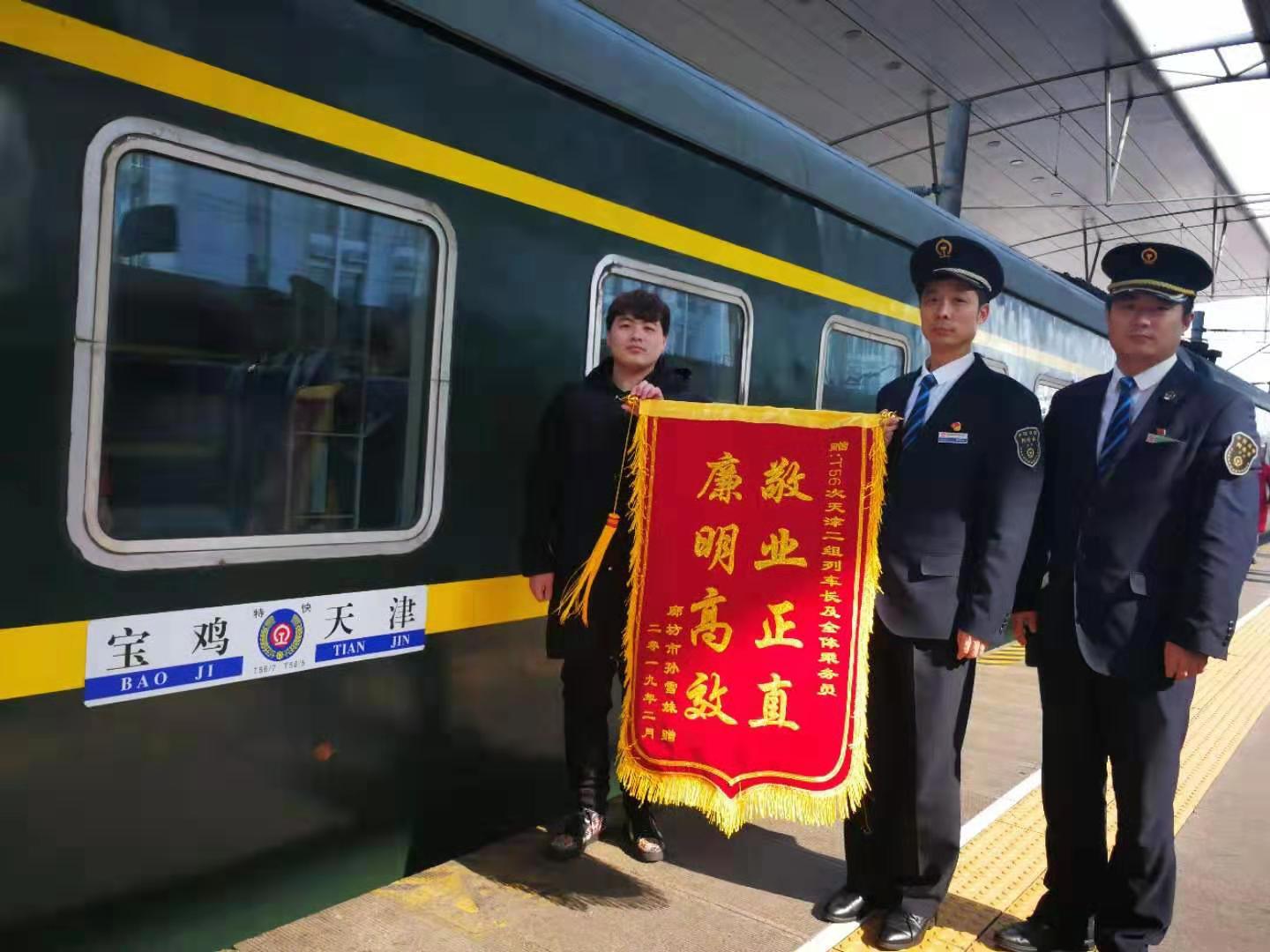
T57 flight attendants receive pennants.

  Recently, T57 arrived at Tianjin Station, the terminal station. After confirming that all the passengers had got off, He Peichen, the flight attendant of No.7 train, started to tidy up the carriage. He found a black backpack in No.59 seat of No.7 train, and he hurriedly handed it to the train conductor. The train conductor and the police chief opened the backpack together and checked it. The bag contained a laptop, 700 yuan cash and a bid-winning contract of 7 million yuan. The train conductor said that this careless passenger lost such an important thing, which might be extremely anxious.

  However, after T58 turned back from tianjin railway station to drive, no passengers came to look for this backpack. Sun Gewen, the train captain, thought it best to check the passenger’s phone number and return the backpack to the passenger as soon as possible, so he opened the backpack again, carefully checked the documents and papers in the bag, and found a phone bill and the user’s name in a pile of documents.

  Captain Sun tried to get through the phone according to the phone number on the bill: "Is that Mr. Gao?" I am the conductor of T57. Did you take our train today? "

  "Uh-huh, yes! I took the T57 train in the morning and took the bus from Xingtai to Langfang North. Why? "

  "Did you leave something in our car?"

  "Let me see, yes, yes, I drank a little more last night. I got off the bus and went home to sleep. I haven’t found it yet. I remember that one of my black backpacks is missing. Did I leave it in your car?"

  "I found the bag. What’s in it?"

  After the owner’s accurate answer to the contents of the bag, the train conductor basically confirmed that Mr. Gao had lost the backpack. Mr. Gao said that he had drunk too much. If the conductor hadn’t called, he didn’t know when or where the bag was lost. On the phone, Mr. Gao thanked the train conductor and the flight attendant of No.7 train again and again, and said that 700 yuan cash in the bag would be used as a thank-you gift. The train conductor refused, saying that every passenger service is what every flight attendant should do.

  The next day, when Mr. Gao saw that his backpack and all the items in it, especially the important contract, were intact, he picked up the phone again and expressed his gratitude to the train conductor, thanking him and flight attendant No.7 for saving him huge losses.

  Afterwards, Sun Gewen, the train captain, reminded the passengers through reporters that travelers must take care of their belongings and luggage to avoid losing and causing unnecessary losses. Railway passenger flight attendants are busy day and night on the thousand-mile railway line. While serving the passengers enthusiastically, they are also carefully caring for the safety of every passenger. (Text/Wang Jianbo, Li Jing)

Forbes released the top 50 global blockchain in 2022, and China enterprises such as Ant, Tencent and Baidu were on the list.

In 2021, cryptocurrencies such as Bitcoin and Ethereum, which once soared and lost more than $1 trillion after November, became the focus of news. In many ways, speculative cryptocurrency is the least attractive blockchain application. As more and more multinational companies integrate blockchain into their daily operations, blockchain is releasing incalculable efficiency and has a far-reaching and lasting impact.

Since its first release, the Forbes Global Blockchain Top 50 list has recorded the use of blockchain technology by about 114 companies around the world (169 companies submitted applications last year). The billion-dollar companies on our annual list (at least one billion dollars in terms of sales or market value) have surpassed the testing project and started to rely on the "distributed ledger" technology to carry out serious work in the background. In addition, whether tracing the source of key elements such as cobalt or tracking auto parts, blockchain is becoming more and more important to the supply chain.

Almost half of the top 50 companies in the blockchain are headquartered outside the United States, and 14% of them are China companies. It is worth mentioning that "venture capital" has become the latest trend in the blockchain field: relevant institutions have invested more than 32 billion US dollars in it in 2021.

The following are the China enterprises listed in the top 50 global blockchain of Forbes in 2022:

  • Ant Group, Hangzhou, China

Since July 2020, this Alibaba subsidiary has invested 10,000 developers in the blockchain. They have created 30 applications and generated more than 100 million blockchain tracking files, including patents, vouchers and warehouse receipts. The most mature application of AntChain is Trusple, which connects international buyers of products and components (such as beads in the clothing industry) with 6 million sellers in China. The application simplifies taxation, customs and transportation, and allows banks to complete payments immediately, reducing audit costs and default risks. Nearly 20 global banks, including Citibank, BNP Paribas, dbs group and Mizuho Bank, provide financing through this platform.

Blockchain platform: AntChain

Core Leader: Jiang Guofei, President of Intelligent Technology Business Group of Ant Group

  • Baidu, Beijing, China

The fourth largest technology company in China has 20,000 developers to develop (mainly) financial applications on its open source blockchain. Last year, they created a revenue of $47 million. For this $15.5 billion (sales) company, this is only nine Niu Yi cents, but the future looks bright. In September last year, Baidu won the biggest contract so far. It signed a $25 million contract with the Tongxiang municipal government in southwest Shanghai to develop supply chain tracking software for the synthetic fibers used by this textile center to produce clothing worth about $5 billion. The efficiency of transferring the workflow to the shared ledger has reduced the loan cost by 50 basis points. Baidu estimates that blockchain has helped the supply chain reduce energy consumption by 17% and can remove 15,000 tons of carbon dioxide from the environment every year.

Blockchain platform: Baidu XuperChain

Core Leader: Xiao Wei, General Manager of Baidu Blockchain

  • China Construction Bank, Beijing, China

The world’s second-largest bank has assets of $4.7 trillion, and has so far handled transactions worth $141 billion in private blockchain, covering everything from supply chain financing to cross-border payment. One of its recent products is EasyPay, which aims to make it easier for enterprises to send large-scale transactions that require a lot of paperwork, thus reducing errors and auditing needs. If a company in Guangxi wants to buy palm oil from Labuan Island, Malaysia, counterparties can store their trade contracts, receipts and waybills in a shared account book. The local branch of China Construction Bank can handle these two transactions in parallel, rather than in sequence. As a result, the summary calculation time has been reduced from 2 days to about 10 minutes. The platform now connects 14,000 bank branches.

Blockchain platforms: Tianshu BaaS, CCB Chain, BC Trade 2.0.

Core Leader: Lei Xing, Senior Manager of China Construction Bank Financial Technology Company.

  • Industrial and Commercial Bank of China, Beijing, China

The world’s largest bank (with assets of $5.6 trillion) has 40 blockchain applications and handled a total of $48 billion in transactions for local governments and industries such as construction and transportation last year. One of the company’s most innovative applications is Icago, which rewards users who use energy-efficient vehicles, whether trains, buses or electric cars. The blockchain of China Industrial and Commercial Bank connects ICBC customers’ wallets with government traffic data. Carbon credits issued by the Transportation Commission as heterogeneous tokens can be exchanged for digital currency, the new central bank of China. In the future, the carbon emissions from securitization will be sold in the form of bonds to companies that want to meet the requirements of carbon emission reduction. In Qingdao, which is famous for its beer, the plan will reduce carbon emissions by 99,000 kilograms in 2021. This year, the project will be extended to Shenzhen, Shanghai, Chengdu and seven other cities.

Blockchain platform: Emperor Seal Chain

Core leader: chief manager Chaowei Liu

  • Ping An (One Account Pass), Shenzhen, China.

Since January 2020, through the blockchain financing platform of its subsidiary, OneConnect, the sixth largest company in the world has issued more than $12 billion in loans to 1 million small and medium-sized enterprises in Guangdong, China Province. Yitongtong’s software uses government data to analyze the borrower’s risk status for banks, shortening the transaction processing time to 10 minutes, saving a lot of money for its 788 financial institutions, including the giant China Industrial and Commercial Bank with a scale of 5.6 trillion US dollars. In November last year, a subsidiary of Yitong cooperated with the People’s Bank of China to track and handle import and export financing from mainland China and Hong Kong, China by using blockchain.

Blockchain platform: One Account Chain (FiMAX)

Core Leader: Li An, Deputy Director of Products

  • Tencent, Shenzhen, China

In the past ten years, Tencent has established a "super application" in China, which has been used by more than one billion people, covering everything from games and social media to information sending and shopping. At present, it is developing a one-stop blockchain platform-Tencent Cloud Blockchain. Ten provinces and cities, including Hainan, Guangdong and Beijing, have used it to issue electronic bills in medical care and transportation. By August 2021, Tencent’s blockchain had handled more than 15 million transactions in one city alone.

Blockchain platforms: ChainMaker, Hyperledger Fabric and FISCO BCOS.

Core Leader: Powell Li, General Manager of Tencent Cloud

  • Weizhong Bank, Shenzhen, China

Weizhong Bank’s latest blockchain application encourages a sustainable lifestyle and rewards users who do things such as walking, taking a bus or recycling clothes. Tencent owns 30% of the shares of this digital bank in China, which issues green points through a small application on WeChat, which can then be exchanged for vouchers and gifts. All records are stored in the blockchain to ensure transparency and traceability. The platform has 1 million daily active users, and it reported that during 2021, the platform reduced its carbon emissions by more than 2,500 tons. Overall, Weizhong Bank has more than 70,000 programmers working on its exclusive "FISCO BCOS" blockchain.

Blockchain platform: FISCO BCOS

Core Leader: Ma Zhitao, Executive Vice President and Chief Information Officer of Weizhong Bank

The complete list of Forbes Global Blockchain Top 50 in 2022:

We analyzed the survey results in the past four years and found some interesting trends.

Seven elders

In the past four years, only seven companies have been on the list every year.

In 2022, several famous backbones, including Microsoft, Cargill and IBM, disappeared from our top 50 blockchain list. Although the members on the list are increasingly diverse—from Sotheby’s and Breitling to Boeing and Andreesen Horowitz)—— there has been a major shift in this year’s list of the top 50 blockchains, that is, the list has obviously shifted to companies that participate in public networks such as Bitcoin and Ethereum, rather than licenses such as Hyperledger. It is worth noting that Microsoft has recently made some news in the field of metauniverse, especially spending $68 billion to acquire Activision Blizzard, but how much of these efforts are based on blockchain remains to be seen.

Eight companies have been selected into the Forbes Top 50 Blockchain list for three times in the past, and they will be listed again in 2022, including Block (Square), China Construction Bank, Fidelity, Mastercard, Meta, Oracle Bone Inscriptions, Tencent and Visa.

Asia is making progress

The blockchain field in Asia is making exciting progress, which is largely driven by China’s current five-year plan. This is a national development plan, which is required by senior government officials to China enterprises: China president said in 2019 that blockchain will "play an important role in the next round of technological innovation and industrial transformation".

In view of this straightforward guideline, Ant Group has specially sent 10,000 blockchain developers to help international buyers establish contact with international banks providing short-term trade financing and 6 million China exporters. Tencent cooperates with 10 provinces and municipalities directly under the central government, including Hainan, Guangdong and Beijing, and uses the company’s blockchain platform to publish electronic bills for medical care and transportation. Asian companies, including India’s Tech Mahindra, currently account for 24% of the top 50 companies in the blockchain, compared with only 8% four years ago. In China, the hotspots of these innovations are Beijing and Shenzhen. South Korea’s leading companies such as Samsung and Kakao, as well as Japan’s Fujitsu and Line companies are also part of this growing Asian team.

The listed companies in Europe have undergone great changes, among which six companies, such as Breitling and Société Générale, have become new listed companies, while 10 companies, such as Telefónica and Swisscom, which were listed last year, have fallen off the list this year.

The competition between Silicon Valley (a company located in Northern California) and Silicon Lane (a financial technology company located in new york) continued this year, and some companies from the hinterland of the United States were squeezed out. For a long time, companies from California and new york have dominated our list, such as Twitter and Adobe on the West Coast, Coinbase and JPMorgan Chase in new york. New york Legion lost IBM, but welcomed BNY Mellon, Sotheby’s and Mastercard. California Legion lost Oracle Bone Inscriptions and VMware, but welcomed Adobe, a16z crypto, Paradigm, Twitter and Meta. However, other big cities in the United States are also very interested in blockchain, and there are 12 listed companies (accounting for 26% of the total list) from New Jersey, Illinois, Virginia and other States, including DCG Group.

Finance still ranks first.

Perhaps it is not surprising that finance is still the largest category among listed companies, because the first application of blockchain-Bitcoin-is a kind of digital currency. Technology (including hardware, software, social media, Internet) applications are closely followed, followed by companies that improve supply chains, manufacturing and healthcare processes.

Two emerging financial segments are asset management and venture capital. Two venture capital funds-Andreessen Horowitz Fund (a16z Crypto) and Paradigm-are on the list for the first time, along with Fidelity Fund and DCG Group. A16z has invested in more than 60 cryptocurrency and blockchain start-ups, recently closed a $2 billion venture capital company, and is rumored to be raising $4.5 billion (new) funds. When Coinbase went public last April, a16z also made a fortune. It is estimated that its stock value has exceeded $4.3 billion. Paradigm, co-founded by Fred Ehrsam, co-founder of Coinbase, recently completed a fund raising of $2.5 billion, which is the largest fund in history.

Venture capital firms are not only on the list because of their shrewd trading ability. These companies are becoming active participants in the network itself, including operating full-scale nodes to guide the network and participating in governance decisions that help define the future of the network.

Blockchain project scale

This year, we also learned the details of how some big companies deal with blockchain. Our analysis shows that in our annual research, 22% of companies use 50 to 199 employees to support their blockchain-related goals, while 18% of companies have 10 to 49 employees in the blockchain field.

Less is more.

There is no doubt that blockchain enterprises have benefited from the bubble market driven by the central bank’s loose monetary policy, but in the past few months, the adjustment of cryptocurrency and stock market has made the bubble subside. The total market value of the top 50 blockchains listed this year is 6.3 trillion US dollars, which is 35% lower than last year’s 9.7 trillion US dollars. The median market value of listed companies this year was $66 billion, compared with $116 billion last year.

By the end of December 2021, the average valuation of a full half of the companies on the list exceeded $50 billion, of which the average size of the seven largest companies was $495 billion. Nevertheless, this is almost half of the average size of the seven largest listed companies in 2021 (it was $964 billion in 2021). One of the main reasons for this change is that Microsoft, Saudi Aramco and LVMH, the three companies with the highest market capitalization, which were listed last year, all dropped out of the list this year.

In the "Top 50 Forbes Blockchain in 2022" list, 54% of companies have annual revenues of more than 10 billion US dollars, compared with 64% last year. The median annual income this year is $18.9 billion, compared with $39.5 billion last year.

Translated by Vivian and Stephen

School | Li Yongqiang

Reporting/feedback

With 23 variety shows and 8 permanent shows, Charlie has become a variety coffee delayed by singing?

In the past two years, the variety market "occupied" by group idols and variety coffee has finally ushered in some new faces.

Singer Charlie taught vocal skills to the contestants in Creation Camp 2021, and officially announced to join "Go online!"! Huacai Junior became the official of Huacai Online, and in the upcoming new issue of Happy Camp, he also joined as a guest and made a contribution to the audience.

Looking back on the variety market in the past two years, Charlie frequently brushed his face in major programs, showed his singing skills and created variety topics through various stage performances, which was dubbed by netizens as "variety coffee delayed by singing". So why can Charlie become a hot variety guest in the variety market where guests are constantly changing?

Become a frequent visitor to variety shows

Charlie is known as a "model worker"

At present, "depression" is still a key word in the mainland music scene. In particular, due to the impact of the epidemic, offline concerts, live performances and other activities have been suspended on a large scale, which has affected many singers and musicians. For singers, how to maintain exposure and attention is a particularly important thing, and variety shows with different styles and different positioning have become a good choice.

More and more singers are keen to participate in variety shows. For example, Hua Chenyu acted as a fixed MC in Ace to Ace, contributing a lot of jokes, while Angela Zhang made brilliant performances in Classic Chanting 4 and Praise for Songs. Among many singers, Charlie is obviously the most active one.

In 2020, Charlie was called "model worker" by many audiences. He has participated in TV variety "Singer’s Year of Playing", "Our Song" and "Travel Notes of Youth Circle 2", and the online comprehensive "Exciting offer2", "Summer of the Band 2" and "The Band Season of Tomorrow".

Charlie has participated in the variety inventory since 2020.

According to incomplete statistics, Charlie participated in 23 variety shows in less than one and a half years, among which, 8 shows, such as The Great Wall, Travel Notes around Youth, and Novice Arrive, were permanent guests, and the rest were flying guests.

Judging from the types of programs he participated in, he can not only perform on the stage in music programs such as Singer’s Year of Playing, Tomorrow’s Son’s Season 4, but also perform brilliantly in outdoor reality shows such as Travel Notes around Youth and The Great Wall, and most of these programs are the head content of brand variety shows or video websites of First-line TV. His lively personality and natural expression make him a hot announcement king.

Besides variety shows, Charlie is also a very sought-after "hot potato" in the New Year’s concerts on various platforms that test the popularity of stars. On the New Year’s Eve in 2021, Charlie shuttled to CCTV, bilibili, CCTV, Jiangsu Satellite TV and Beijing Satellite TV, and showed the audience a "depth-dividing technique".

Charlie made her debut in the third season of The Voice of China in 2014. But soon, the fame brought by the draft was drowned by waves of new people. After a few years, Charlie, like many draft singers, became a "small transparency" in the entertainment circle. In May, 2016, the national wind song "Big Fish" swept the major music platforms, and Charlie also gained some popularity with this song. Since then, although he has also participated in Jiangsu Satellite TV’s "Masked Singer Guess" and Tencent’s video "I Love the Second Yuan", it has always been tepid.

In 2018, Charlie stepped onto the stage of Sound Into People’s Hearts. Her soft voice and clear voice conquered the hearts of the producers, and Liao Changyong, a leading figure in the bel canto world, praised her as natural. With the increasing popularity of the show, Charlie also began to gain a large number of fans. After years of polishing in the music world, he finally gained a certain popularity.

In 2020, Charlie joined two music variety shows, Our Song and Singer’s Year of Playing. With a recognizable voice and just the right sense of variety, he sent topics such as # Charlie Monster# and # Charlie’s Back to the White Wall Live Competition # to Weibo Hot Search. While harvesting a large number of fans, he has also become a frequent visitor to major variety shows and an artist with rising exposure among singers.

In fact, singers and actors often have problems such as lack of sense of variety and unpleasant people when they participate in variety shows. However, Charlie’s performance in variety shows was remarkable and was welcomed by the audience.

On the one hand, Charlie has outstanding strength in the professional field. In Our Song, Charlie and Hacken Lee formed a "diligent and deep" combination, unique interpretation and tacit cooperation, and finally won the "Golden Voice Partner"; In Classic Chanting 3, as a classic singer, he brought a poem "Touching Fish and Yanqiu Ci". Kang Zhen, an appreciation group, said, "We are always so busy in life and work, and when we hear voices like nature, we feel that the whole person seems to have been liberated."

On the other hand, Charlie has excellent ability of throwing stalks and grafting stalks in variety shows. For some singers and actors who lack variety experience, it is not difficult to get rid of the idol burden, but for Charlie, it doesn’t seem to be a difficult thing, such as telling jokes, producing expression packs and imitating performances.

In Travel Notes of Youth Circle 2, Charlie’s partner Yang Di imitated CoCo Lee’s "Tick-tock" rollover scene, which triggered the hilarity of the guests on the scene; In "Creation Camp 2021", he is also full of golden sentences. The contestant introduced himself that the best result in the long jump was 7.4 meters. Charlie teased in surprise that 7.4 meters was five selves. When he saw the contestant singing too hard, he also laughed that it was a man with a barrage on his face, and the program was full.

To sum up, excellent talent, high cooperation and high cost performance may be the reasons why Charlie has become a frequent visitor to variety shows.

Being questioned as "doing nothing"

How can singers make good use of the "double-edged sword" of variety show?

Variety shows provide artists with a platform to show themselves, which improves the popularity and exposure of artists. For example, although singer Mao has released a new album, held an online concert and won many music awards in the past two years, according to Baidu index, his personal popularity peak is still during his participation in "The Year of Singer". However, when an artist frequently appears in a studio that is not related to his career, he will always receive questions about "doing nothing", whether it is an actor or a singer.

Frequent appearances in variety shows have triggered a "war" between fans and artists. Last year, Allen’s fans made a long speech in Weibo, saying that it took about 50 days to shoot in a year, but they took over four variety shows, and their main work revolved around variety shows; Justin, who debuted as a member of NINE PERCENT Men’s Team, was also questioned as a "variety coffee" by participating in the variety show "Saving the Country by Curves" after the dissolution of the group.

In the eyes of many fans, frequent participation in variety shows constantly consumes the "mystery" of artists, and a little carelessness in the program will also affect the reputation that artists have accumulated. After participating in more than 20 variety shows in succession, Charlie seems to have begun to face the same question of "doing nothing". Some netizens think that he is gradually losing his original intention as a singer, and some netizens call for him to stop being a variety coffee.

Has Zhou Shen been delayed by the variety show? In the past year, Charlie released 32 original songs and 40 arranged songs, which is equivalent to releasing more than two original songs in one month. However, although the number is considerable, in the audience’s impression, apart from the "Big Fish" a few years ago, there are not many original songs that he really made a circle. Most of the hot searches are scenes of his cover songs in variety shows and parties.

For a singer, spending a lot of time on variety shows is, to some extent, an excessive consumption. However, in the era of traffic, almost every singer who participated in variety shows got more opportunities to be exposed after having a certain degree of popularity, which helped him to go further.

The broadcast of "Summer of the Band" made the new pants band enter the public’s sight; Liu Mintao’s chorus "Do you want to dance" broke the dimensional wall, and "Guest" and "Sister Riding the Wind and Waves" brought a high-burning stage and received many commercial advertisements; With variety shows such as "The Masked Singer Will Guess" and "The Voice from Heaven", Angela Zhang, who has been against the music scene for many years, has also ushered in the second spring of his career.

Variety traffic is undoubtedly a "double-edged sword" for singers. It is the original intention of many singers to participate in the program to gain popularity by participating in variety shows and return to music creation when the time is ripe. However, after getting used to the lively laughter of variety shows and the rapidly growing popularity, it is probably a big test for many singers to return to the initial heart of music creation. In the face of the double-edged sword of variety show, singers should really think about how to grasp it.

Author | Li Yang

Editor | Peng Kan

Edit | Hu Yuxin

Typesetting | Li Kexin

Detective No.08 Mid-Autumn National Day holiday is coming, and Beijing Traffic Management announces details of traffic jams.

The Mid-Autumn National Day holiday in 2023 lasts for 8 days from September 29th to October 6th. The Beijing Traffic Management Bureau reminded that during the period, the tail number of motor vehicles is not limited, and the expressway is free of passenger car tolls. The traffic control department of Beijing announced the pre-judgment of road traffic flow during the Mid-Autumn National Day holiday, and the sections that are easy to be congested, dangerous and accident-prone, and issued road traffic safety tips.

The traffic pressure on the night before the festival is outstanding, and the peak on the evening of September 28 will be advanced.

The Beijing Traffic Management Bureau reminds that there are only four working days this week. Due to the increase in activities such as visiting relatives and friends, gathering and shopping before the festival, the traffic flow will increase on the evening of 2-3 days before the festival, and the evening peak will be extended. The duration is expected to be from 17: 00 to 21: 00. September 28th (Thursday) is the last working day before the holiday, and the evening rush hour will be advanced. The traffic pressure on urban roads and all high-speed exits from Beijing will gradually increase from noon to afternoon, and the travel peak is expected to appear from 15: 00 to 22: 00, and the traffic flow will be concentrated in all high-speed exits from Beijing at night.

During the evening rush hour, the traffic flow in the direction of leaving the city is concentrated in some sections of the East, West, North Second, Third, Fourth and Fifth Ring Roads and the East Sixth Ring Road, as well as urban roads from Wanquanhe Road to Yuanmingyuan West Road, Tonghuihe North Road and Lianshi East Road, and the traffic flow in the direction of leaving Beijing is large on expressways such as Beijing-Tibet Expressway, Jingcheng Expressway, Jingtong Expressway, Beijing-Hong Kong-Macao Expressway and Airport Expressway.

The tidal characteristics of expressway traffic leaving Beijing in the morning and entering Beijing in the afternoon are obvious.

The traffic control department predicts that during the holiday period, there will be traffic peaks on major expressways such as Beijing-Tibet, Jingcheng, Airport, Beijing-Hong Kong-Macao, Jingkai, Beijing-Shanghai and Jingha, which will leave Beijing in the morning and enter Beijing in the afternoon, and the traffic will be concentrated in the morning from September 29 to October 2 and in the afternoon from October 3 to 6.

On the mornings of holidays, the traffic pressure on Beijing-Tibet, Jingcheng, Airport, Beijing-Hong Kong-Macao, Jingkai, Beijing-Shanghai and Jingha expressways and some national highways will increase obviously, including the Beijing-Tibet Expressway from the north of Xiguan to the exit of Kangzhuang, Qinghe Toll Station, Shahe Bridge, Wildlife Park, Miyun Section of Jingcheng Expressway, Shunyi Section, Huanggang to Laiguangying Bridge, Jingli Expressway, Dawayao Bridge of Beijing-Hong Kong-Macao Expressway to the city boundary, and Jingkai Expressway. From September 29 to October 2, the traffic pressure was prominent from 7 am to 12 am.

From 14: 00 pm to 19: 00 pm, the traffic pressure of Beijing-Tibet, Jingcheng, Beijing-Hong Kong-Macao, Beijing-Shanghai, Jingkai and Airport increased, and the traffic flow of Beijing-Tibet Expressway Kangzhuang, Juyongguan, Xisanqi, Beishatan, Jingcheng Expressway Huanggang and Taiyanggong, Beijing-Hong Kong-Macao Expressway Liulihe, Xidaokou, Jingkai Expressway Yuquanying, Xinfadi and Yufa was concentrated. From 13: 00 pm to 20: 00 pm on October 3 to 6, the traffic pressure was outstanding.

During the holidays, temporary traffic management measures will be taken in Tiananmen area and Xiangshan area.

It is worth noting that from 0: 00 on September 29 to 24: 00 on October 6, temporary traffic management measures were taken to prohibit vehicles from passing through the east side road and the west side road of Tiananmen Square (except motor vehicles with special activity passes). Passing vehicles (including public electricity and cars) can bypass Zhengyi Road and Renmin Hall West Road.

From September 29th to October 6th, from 7: 00 to 19: 00 every day, Nanxincun Street (section from Hongfeng Road to Xiangshan South Road) is prohibited from driving from east to west.

At 10: 00 on September 30th, Tiananmen Square will hold a "Martyrs’ Day" ceremony to present a flower basket to the people’s heroes. From 6: 30 in the morning to the end of the event, temporary traffic management measures will be taken on the east and west roads of Tiananmen Square, Chang ‘an Street, Qianmen East and West Street and some roads around Tiananmen Square, and vehicles and pedestrians are prohibited from passing, and buses will also stop or detour. Citizens and friends who travel from morning to morning should pay attention to the specific information and adjust their travel plans in time.

The passenger flow and traffic volume around some traffic stations are large.

At the same time, the traffic control department expects that the passenger flow of Beijing West Railway Station, Beijing South Railway Station, Beijing North Railway Station, Qinghe Railway Station, Beijing Chaoyang Railway Station and Beijing Fengtai Railway Station, as well as the "seven stations and two games" of Capital Airport and Daxing Airport, will be large, and vehicles will queue up on the surrounding roads.

Recently, the municipal public security traffic control department has taken comprehensive optimization measures for Beijing Railway Station and Beijing West Railway Station, such as adjusting traffic streamline, optimizing parking lot settings, adding guidance signs, and strengthening navigation guidance. Please know the changes of pick-up and delivery channels in advance when going to the two stations, and you can stop and leave at the first and second drop-off areas when going to Beijing Railway Station. Beijing West Railway Station, from the east to the north, can be sent to the temporary drop-off areas on the east and west sides of the sinking square at the south exit of Yangfangdian Road; From lianhua bridge District to Beijing West Railway Station, please follow the road traffic signs, and the pick-up station can enter the B1 express pick-up channel.

Subway and bus lines are connected around the traffic station, so it is recommended to take public transportation such as subway. Please specify the pick-up time and place when you make an appointment to pick up and drop off vehicles, so as to avoid long-term parking in the stop-and-go area that will affect others’ traffic.

Folk tourism in suburbs heats up, and the traffic flow of national highways and provincial highways increases.

At the same time, the traffic control department reminded that in recent years, folk tourism and farmhouse music in the suburbs have continued to heat up, and in autumn, the enthusiasm of citizens to go to vegetable gardens and orchards in the outer suburbs to pick fruits and vegetables has increased. 101, 107, 108, 110, 111, 234 and some provincial roads may have short-term slow traffic.

The giant flower baskets placed in Tiananmen Square and the theme flower beds arranged along Jianguomen to Fuxingmen in Chang ‘an Street will attract people to visit, and the traffic pressure along Chang ‘an Street and Qiansanmen Street will increase at night. Light shows in CCTV Tower, Wangjing, CBD, Zhongguancun and East Third Ring Road will also attract people to visit.

Short-term traffic concentration on the roads around the venue of large-scale events.

On September 30th, a football match will be held at the Workers Stadium. From September 26th to October 8th, the China Open will be held in the National Tennis Center. During the holidays, performances and other themed activities will also be held in Wukesong area, Beijing World Garden Park, Tianqiao area, National Grand Theatre, National Culture Palace Grand Theatre, Exhibition Hall Theatre, Changyang Music Theme Park, Sanlitun area and Tongzhou Canal Cultural Square. Before and after the entrance, there will be short-term traffic concentration on the roads around the event venue.

The traffic control department announced 10 traffic accident-prone spots.

Judging from the road traffic accidents during the National Day holiday in recent three years, the main features are as follows:

First, the risk of traffic accidents in the middle of the holiday is outstanding, and there is a trend of frequent accidents on October 4.

Second, accidents in the suburbs are prominent, among which Tongzhou, Daxing, Shunyi and Fangshan have more accidents, and the total number of deaths in the four districts accounts for over 60% of the city. Affected by the rain and floods at the end of July this year, some scenic spots and roads in Fangshan and Mentougou were closed, and some tourists chose the scenic spots in the northern and eastern suburbs instead. It is expected that the traffic safety risks in the northern and eastern suburbs will increase this year.

Third, the accidents of large trucks are prominent, especially the accidents of large trucks on expressways account for a relatively high proportion.

Fourth, alcohol-related accidents are prominent, especially accidents caused by driving motorcycles and passenger cars after drinking.

Fifth, highway accidents are prominent. There are many accidents in Beijing-Tibet Expressway, Sixth Ring Road, Beijing-Hong Kong-Macao Expressway and Jingcheng Expressway. The total number of daily accidents in the four expressways in the past three years accounts for over 70% of the city. It should be noted that in the past three years, many highway accidents occurred, all of which were caused by accidents on the front road section, slow queuing of vehicles at the rear and too fast braking of the vehicles involved. When traveling on the expressway, if there is an abnormal traffic flow caused by vehicle queuing or accidents, you should beware of traffic safety risks.

Combined with the data of the past three years, the Beijing traffic control department announced the top ten road sections with frequent traffic accidents during the Mid-Autumn National Day holiday in 2023. They are Jingcheng Expressway, Fifth Ring Road and Jingha Expressway in Chaoyang District; Sixth Ring Road, Tongzhou District; Jingkai Expressway in Daxing District; Beijing-Hong Kong-Macao Expressway in Fangshan District; Beijing-Tibet Expressway, Beijing-Tibet Expressway auxiliary road and Sixth Ring Road in Changping District; Jingjia Road (National Highway 111), Huairou District.

The police issued travel safety tips

The police suggested that citizens should make preparations in advance and plan their trips reasonably. Choose the destination, mode and time of travel reasonably, and pay attention to the dynamic information of travel through navigation software, traffic broadcast and the official Weibo of "Beijing Traffic Police", so as to travel rationally at different peaks. Before driving, check the safety status of the vehicle and the tools on board to ensure that the vehicle is in good technical condition. Don’t illegally occupy emergency lanes when roads near highways and city entrances and exits are congested during holidays.

At the same time, strictly abide by traffic laws and regulations, and travel safely and civilized. Ensure adequate sleep before driving and avoid fatigue driving; Consciously resist drunk driving, speeding, fatigue driving, distracted driving and other illegal acts; Be sure to fasten your seat belt when driving a car, and wear a safety helmet when riding a motorcycle or an electric bicycle. Slow down at night and try not to drive at night; Civilized and courteous driving, avoid overtaking and passing by force.

Put an end to impatience and drive safely and steadily. When driving on the expressway, it is necessary to maintain a safe distance and a specified speed. When vehicles queue up, we must restrain impetuous emotions, do not blindly overtake and merge at will, and actively cooperate with the command and guidance of the on-site police. In the event of minor traffic accidents such as scratching and rear-end collision, the vehicle should be moved quickly after taking photos and recording, and the solution should be negotiated by itself to reduce the road occupation time. At the same time, do a good job of self-protection. If there is a traffic accident on the expressway, remember that "the car pulls over and people evacuate, that is, call the police" to avoid secondary accidents.

Passing through the scenic mountain area, slow down and keep the road safe. During the holidays, there are many vehicles in the scenic spots and mountainous areas in the outer suburbs. In case of sharp bends and steep slopes, long downhill roads and roads facing the water and cliffs, you should slow down, overtake carefully and drive without occupying the opposite lane. When passing through rural and mountainous roads, you should pay attention to the vehicles and pedestrians on both sides of the road. The roads around the scenic spot are crowded, so it is necessary to avoid pedestrians and regulate parking.

Passenger cars operate in accordance with the law and take regular vehicles. Don’t take buses that solicit tourists privately, operate illegally or carry passengers in excess. If you find illegal behaviors such as overcrowding, speeding and fatigue driving, please report them to the public security traffic control department in time.

Text/Beijing Youth Daily reporter Wang Haoxiong

Editor/Ni Jianing

Reporting/feedback

Looking at the "Strong Grassroots" of Medical and Health Services from a Set of Figures

On June 5th, the medical staff of Nanhe District People's Hospital in Xingtai City, Hebei Province went deep into the countryside to carry out free clinic activities at the grassroots level, and examined the eyes of the villagers in Sushi Zhang Cun, Jiasong Town. Xinhua News Agency (photo by Zhang Chi)

On June 5th, the medical staff of Nanhe District People’s Hospital in Xingtai City, Hebei Province went deep into the countryside to carry out free clinic activities at the grassroots level, and examined the eyes of the villagers in Sushi Zhang Cun, Jiasong Town. Xinhua News Agency (photo by Zhang Chi)

  90% families can reach the nearest medical point within 15 minutes, and basically all cities and counties (cities, districts) will carry out family doctor contract service … … The National Health and Wellness Commission held a press conference on July 14th to introduce the progress and effectiveness of primary health care services since the 18th CPC National Congress. A set of numbers reflects the changes in these 10 years.

  There are over 4.4 million primary medical and health personnel.

  By the end of 2021, there were nearly 980,000 grass-roots medical and health institutions in China, with more than 4.4 million health workers, achieving full coverage of streets, communities, towns and villages. The sixth statistical survey of health services shows that 90% of families can reach the nearest medical point within 15 minutes.

  In 2012, there were more than 910,000 primary medical and health institutions and about 3.4 million health workers.

  In addition, in the past 10 years, the number of beds in primary medical and health institutions has increased from more than 1.32 million to more than 1.71 million, and the number of medical practitioners and assistant medical practitioners in primary medical and health personnel has increased from 1.009 million to 1.615 million.

  In Xishui County, Zunyi City, Guizhou Province, since the "Thirteenth Five-Year Plan", the county has increased the establishment of 1,200 health technicians, and 200 undergraduate and above personnel are openly recruited every year to enrich the county and township medical institutions. Ran Chongqing, the county magistrate of Xishui County, said that up to now, a total of 1.8 billion yuan has been invested in the standardization construction of tertiary medical institutions in counties and villages, and the service capacity at the grassroots level has been greatly improved, and the rate of medical treatment in the county has reached 92.6%.

  "The network of primary medical and health institutions has been continuously improved, the capacity of primary medical and health services has been continuously enhanced, and the new operating mechanism of primary medical and health institutions has been improved." Nie Chunlei, director of the grassroots department of the National Health and Wellness Commission, said.

  The proportion of primary diagnosis and treatment has remained above 50% for a long time.

  "Strengthening the grassroots" is an important principle and work content for deepening the reform of medical and health system. According to reports, the current proportion of primary medical treatment has remained above 50% for a long time.

  Nie Chunlei introduced that in order to continuously improve the capacity of primary health care services, the National Health and Wellness Commission has successively carried out activities such as "creating a demonstration community health service center", "township hospitals satisfied by the masses" and "providing quality services at the grass-roots level", introduced the capacity standards of health centers and community health service centers, improved the basic infrastructure conditions, and upgraded facilities and equipment. At present, all eligible grass-roots institutions are included in the new rural cooperative medical system, urban and rural residents’ medical insurance and urban workers’ medical insurance.

  In view of the phenomenon that the proportion of outpatients in primary medical and health service institutions has declined in recent years, Nie Chunlei said that the actual number of outpatients is still rising, and the measurement of primary medical and health institutions depends on comprehensive service capabilities, including normalized epidemic prevention and control and other public health service capabilities.

  Set up 320,000 village (neighborhood) public health committees.

  It is reported that at present, 320,000 village (neighborhood) public health committees have been set up in China to lay a solid foundation for community prevention and control of the epidemic in COVID-19.

  The epidemic situation is a "big test". Since the outbreak, China’s basic medical and health institutions have played the role of "sentinel" and "probe" on the basis of completing basic medical services, and undertaken a large number of epidemic prevention and control work such as screening, transshipment, epidemic adjustment, nucleic acid sampling and vaccination.

  This is also a microcosm of the improvement of grassroots public health service capacity. "Every year, hundreds of millions of hypertensive patients and more than 35 million diabetic patients need their follow-up, more than 10 million pregnant women and newborns need their visits, tens of millions of children need their vaccination services, and more than 100 million elderly people aged 65 and over need health checkups … …” Nie Chunlei said that the service capacity of primary health care institutions is steadily improving.

  Set up more than 420,000 family doctors.

  By the end of 2021, all cities and counties (cities, districts) in China have basically implemented family doctor contract services and established more than 420,000 family doctor teams.

  "After signing the family doctor service, residents can get basic medical care, preventive health care and health guidance." Zhang Yalan, director of the South Mill Community Health Service Center in Chaoyang District, Beijing, introduced.

  Taking Chaoyang District as an example, the "1+6+N" characteristic family doctor contract service model is implemented: 1. Basic service package, suitable for the general population, which mainly includes basic medical care, public health and general health management; 6 is a personalized service package, which is mainly aimed at key groups, such as follow-up of patients with chronic diseases, health care for women and children, physical examination for the elderly, etc. N is a customized service package, which is aimed at special people recognized by civil affairs, disabled persons’ federations and other departments and can enjoy on-site service.

  "However, family doctors are not home doctors or private doctors." Zhang Yalan said that the contract service of family doctors is actually a change in service mode, and it advocates a long-term and stable contract service relationship, which can provide medical and health services including long-term prescriptions for key people such as contracted residents, especially chronic patients and the elderly.

What are the new opportunities for the development of Chengdu digital economy after the establishment of Chengdu Data Group? | Chengdu Development

Cover journalist Yang Ruiwen Zhao Yi

On July 5, Chengdu Data Group Co., Ltd. (hereinafter referred to as "Chengdu Data Group") was officially unveiled. As the first state-owned enterprise group with data as its core business in Chengdu and Chongqing, Chengdu Data Group has anchored the development vision of "the first-class digital economy ecological builder in China".

Looking at the overall situation, Chengdu’s digital economy is developing at a constant pace.

Chengdu data group unveiled

In 2022, the added value of Chengdu’s digital economy core industries was 277.951 billion yuan, accounting for 13.4% of the city’s regional GDP, up 0.3 percentage points from the same period of last year, accounting for 64.3% of the added value of the province’s digital economy core industries.

In the digital age, behind the continuous development of new infrastructure, industrial digitalization and digital industrialization in Chengdu, what new opportunities are there for Chengdu’s digital economy?

Look at the bottom spirit:

Chengdu’s digital development ability ranks sixth in China and first in new first-tier cities.

On July 5th, Chengdu Data Group was officially inaugurated. Under this background, Chengdu Canada has taken a key step to accelerate the cultivation of data factor market, promote the development of digital economy, and help the industry to build a strong chain and the digital transformation of the city.

A glimpse of autumn, from the establishment of Chengdu Data Group, where does Chengdu’s confidence come from, chasing the blue ocean of digital economy?

According to the Research Report on the Development of Digital Economy in China in 2022, Chengdu ranks sixth in the list of the top 100 digital economy cities in 2022, following Shenzhen, Hangzhou and Guangzhou in the north, and ranks first in the new first-tier cities.

Chengdu Arithmetic Center (Image courtesy of Chengdu Arithmetic Center)

Entering the computer room of the artificial intelligence computing platform of Chengdu Intelligent Computing Center, the indicator light of the cabinet server flashes alternately. On the side of each cabinet, there is a red "Tiangong" logo. This is the "super brain" of Chengdu Intelligent Computing Center. As the hub node of Chengdu-Chongqing National Integrated Big Data Center, the computing power of Chengdu Intelligent Computing Center reaches 300 PFLOPS, which can be used for the cutting-edge research of artificial intelligence technology innovation.

In addition, as early as 2021, Chengdu’s software and information service cluster was selected as the winner list of the advanced manufacturing cluster of the Ministry of Industry and Information Technology, which means that Chengdu undertakes the national mission of participating in global competition and cooperation on behalf of China.

In the same year, Chengdu National Pilot Zone of Artificial Intelligence Innovation and Application was unveiled in Chengdu High-tech Zone, and six major artificial intelligence projects, including the National Industrial Cloud Manufacturing Innovation Center, were settled in Chengdu High-tech Zone, with a total investment of 3.25 billion yuan. The highest computing speed of Chengdu Supercomputing Center reaches 1 billion times per second, and its computing power ranks among the top ten in the world, which has also become an important information infrastructure supporting the development of digital economy.

The continuous improvement of the digital foundation also breeds the development opportunities of Chengdu. Sino-German cooperative intelligent networked automobile and vehicle networking standards and test verification pilot demonstration projects, such as Sichuan Experimental Base, National Digital Service Export Base, China (Chengdu) Ultra-high Definition Innovation and Application Industrial Base, have brought new opportunities for digital new infrastructure, which has brought "opportunities" for Chengdu to seize the new track.

Starting from the policy, Chengdu has also been building a solid foundation for digital development. This year’s work report of the Chengdu Municipal Government clearly stated that the construction of the core area of the National Digital Economy Innovation and Development Experimental Zone should be deepened, the deep integration of the digital economy and the real economy should be promoted, and the added value of the core industries of the digital economy should be increased to more than 14% of the regional GDP.

It is worth mentioning that the Third Plenary Session of the 14th Chengdu Municipal Committee held last week also proposed to strengthen the base of new infrastructure, promote the construction of smart transportation, smart energy and digital municipal services, create a smart Rongcheng application scenario and build a "digital twin city".

Grasp the implementation:

More than 2,000 national high-tech enterprises have been newly cultivated this year.

Chengdu’s "14th Five-Year Plan for Digital Economy Development" points out that by 2035, Chengdu should have strong and sustainable digital technology innovation strategy capability and digital economy innovation vitality, and build a new highland of digital economy with international competitiveness in an all-round way.

From a macro point of view, at present, Chengdu is taking the opportunity of building a national digital economy innovation and development experimental zone, focusing on the transformation of production technology from traditional "hard" elements to new "soft" elements based on "cloud, network, terminal and number", and making efforts to create a new engine of digital economy development through the two-wheel drive of "digital industrialization" and "industrial digitalization" to empower the high-quality development of urban economy and society.

Previously, Chengdu has vigorously promoted the pilot application of industrial Internet, digital workshops and smart factories, so as to promote the digital transformation and upgrading of manufacturing industry.

Among them, Panzhihua Iron and Steel Group, Jiwei IOT and Alibaba Cloud cooperated to build the first "steel brain" in China; Chengdu Zhongdian Panda Display Technology Co., Ltd. achieved a monthly production capacity of 140,000 display screens through industrial internet technology without increasing hardware investment, which was 20,000 more than the designed production capacity, with a vertical increase of 15% and an increase of 25% in operational efficiency.

Based on the current situation, what are the highlights of digital construction in Chengdu?

At the Third Plenary Session of the 14th Chengdu Municipal Committee, Wang Fengjun, Party Secretary and Director of Chengdu Development and Reform Commission, proposed to accelerate the construction of Chengdu-Chongqing (Xinglong Lake) comprehensive science center scheme and major scientific and technological infrastructure layout, and create an innovative source of service strategy rear area construction.

Wang Fengjun, Director of Chengdu Development and Reform Commission

He revealed that the plan of Chengdu-Chongqing Comprehensive Science Center has been completed, and Chengdu will build a high-end innovation resource bearing place and a major original innovation source around the advantageous fields such as aerospace, advanced energy, information technology and life sciences.

Not only that, but also promote the development of 28 key industrial chains in 8 industrial ecological circles, focus on the future industrial forward-looking layout of new tracks, accelerate the shaping of new advantages, and build a modern industrial system led by scientific and technological innovation.

"This year, more than 2,000 national high-tech enterprises have been newly cultivated, more than 50 national specialized and innovative" little giant "enterprises, more than 300 new industrial enterprises, more than 500 service enterprises, more than 20,000 new Shangyun enterprises and more than 15 newly listed enterprises." Wang Fengjun said.

Look at opportunities:

Deep integration of digital technology and real economy

Vertically subdivide service scenarios base on computing power

Under the influence of the digital age, in the eyes of entrepreneurs in the digital field, what new opportunities are there for Chengdu’s digital economy?

On July 10th, the cover journalist interviewed Yuan Haojie, deputy general manager of Chengdu Gaoxin Vision Digital Technology Co., Ltd., and made relevant suggestions for speeding up the digital transformation of Chengdu.

From the establishment of the New Economic Development Committee five years ago, to the proposal of building a smart city, and then to the release of the list of opportunities for cities with smart cities, the construction of digital economy in Chengdu is imperative, and it also gives birth to new opportunities for development.

"The deep integration of digital technology and real economy is a great opportunity for the development of Chengdu’s digital economy. For example, Smart Rongcheng integrates traditional urban governance and digital technology to form a two-wheel drive model of technology and business."

Yuan Haojie said that this will also give birth to new business models such as smart business districts.

In addition, using the Internet of Things to build a smart Rongcheng, Chengdu has formed a good model. "A large number of Internet of Things technologies are used to achieve urban management through some sensor devices and to achieve refined governance of megacities. In the next step, Chengdu can lead enterprises out of Sichuan and create more development opportunities. "

"The combination of new energy and artificial intelligence will also be a good direction." He said that through artificial intelligence technology, intelligent power generation and energy storage can be realized, and intelligent services can be provided for transportation and home. In the long run, it is also a deep combination of digital economy and double carbon targets, providing new ideas for environmental protection.

In Yuan Haojie’s view, although the digital economy is a new thing, it has experienced long-term exploration, including the establishment of the National Data Bureau at the beginning of this year, which also provides a top-level design for the further growth and explosion of the digital economy in the future.

Based on the reality of Chengdu’s digital economy, where is the future focus?

"In addition to the digital super-large model construction, we can also vertically subdivide the service field based on the current computing power advantage of Chengdu. For example, for government affairs or people’s livelihood service scenarios, some solutions can be quickly formed according to actual needs to make digital construction more precise, personalized and practical. At the same time, attract more enterprises to join and make digital services bigger and stronger. " According to Yuan Haojie, there are currently two national innovation centers in Chengdu, Supercomputing and Intelligent Computing, which have laid a good foundation for further providing better digital service scenarios.

In addition, it is necessary to further explore the integration of public service data resources, and consider how to accelerate the integration of public data such as education, health, transportation, and cultural tourism to promote the development of digital economy while ensuring data security and protecting privacy rights. "Data is the hub of digital development. For example, Chengdu Data Group, which was just established last week, can provide a data base for the future construction of various fields in Chengdu and lay a solid foundation for development."

"At present, the supply of talents in Chengdu is abundant. How to turn the’ big market’ of talents into a’ strong market’ of talents, give full play to the ability of existing talents, and attract more talents in the head field such as artificial intelligence to come to Chengdu and stay in Chengdu, which requires continuing to improve the corresponding talent policy." He said that talent is a "think tank" for the development of digital economy, and special attention should be paid to it.

"The current digitalization process in Chengdu can be said to be a stage of large-scale expansion or deep application." In Yuan Haojie’s view, Chengdu’s digitalization process has entered the first phalanx in the country, and it has a good development direction and motivation both now and in the future.

Vanke, the latest release

  [Introduction] Vanke’s revenue in the first three quarters was nearly 219.9 billion yuan and 113,000 suites were delivered.

  On the evening of October 30th, Vanke Enterprise Co., Ltd. (hereinafter referred to as Vanke) released its report for the third quarter of 2024. According to the third quarterly report, Vanke’s revenue in the first nine months was 219.89 billion yuan, and all public bonds were paid during the year.

  Vanke’s revenue in the first nine months was 219.89 billion yuan.

  The data shows that from January to September this year, Vanke’s accumulated operating income was 219.89 billion yuan; The net loss attributable to shareholders of listed companies was 17.94 billion yuan.

  Among them, Vanke achieved operating income of 77.12 billion yuan in the third quarter; The net loss attributable to shareholders of listed companies is 8.09 billion yuan.

  Regarding this performance loss, Vanke explained in the quarterly report that it was mainly due to the decline in the settlement scale and gross profit margin of development business, provision for impairment, some non-main financial investment losses, and the transaction price of some assets and equity was lower than the book value.

  According to the announcement, from January to September, the gross profit margin of Vanke’s real estate development business was 8.3% before tax, 2.7% after deducting taxes and surcharges, 9.5% before tax and 4.9% after tax.

  In fact, under the deep adjustment of the industry, the loss of housing enterprises is a common phenomenon, and the current first priority of housing enterprises is to ensure the safety of cash flow. According to the incomplete statistics in the semi-annual report period, over 60% of listed housing enterprises suffered losses, and the accumulated losses exceeded 100 billion yuan.

  "In the case that the market scale has shrunk significantly in the past two years, full sales means trading at a price, and asset transactions have to be sold at a loss. The price of survival with a broken arm is often a big loss. In addition, the high-priced and restrictive land used in the high-speed development stage has further squeezed profits. Under the superposition of various factors, losses are more common. " A capital market person said.

  All public bonds have been paid this year.

  The third quarterly report shows that during the reporting period, Vanke continued to carry out its work around "guaranteeing the delivery of houses, guaranteeing payment, and transforming high-quality development".

  In terms of delivery, in the first three quarters, Vanke completed the delivery of 113,000 suites on schedule with good quality, continued to promote the work of handing over certificates upon delivery, promoted property services in 51 large-scale projects, improved community business, transportation and education facilities, and created a community atmosphere. The increase in occupancy rate also promoted project sales.

  It is understood that Vanke’s sales in the first three quarters exceeded 180 billion yuan, which outperformed the market. During the year, all new investment projects achieved 100% cash opening. Since 2023, the inventory capacity has exceeded 47 billion. After a series of policies were introduced at the end of September, Vanke also actively grasped market opportunities and achieved hot sales in many places.

  It is understood that in recent years, Vanke has actively developed cutting-edge products that adapt to urban development trends, achieving hot sales in many first-tier and provincial capital cities, and its sales have remained at the forefront of the industry.

  As a head housing enterprise, Vanke’s cash flow and financing situation have also received much attention from the market. In terms of public debt payment, in the third quarter, the Group achieved a net operating cash flow of 330 million yuan, which has remained positive since the second quarter.

  According to the third quarterly report, as of the end of September, Vanke had completed the repayment of 19.7 billion yuan of public debt, and repaid about 70 billion yuan of interest-bearing debt in the first three quarters. There were no domestic and foreign public bonds due during the year.

  Vanke said that during the reporting period, the Group took various measures to promote payment and ensure the smooth payment of public debts, including insisting on active sales, revitalizing existing resources, promoting bulk asset transactions and expanding asset withdrawal channels.

  Among them, in terms of expanding asset exit channels, Vanke and CITIC and Taikang jointly established CITIC Vanke Consumer Infrastructure Pre-REIT Fund, and signed contracts for Shenzhen Longgang Vanke Plaza and Beijing Jiugong Vanke Plaza projects.

  By the end of September, Vanke’s interest-bearing liabilities totaled 327.61 billion yuan, of which interest-bearing liabilities for more than one year accounted for 64.4%; The net debt ratio was 66.2%, and the asset-liability ratio excluding advance receipts was 65.4%, down 0.1 percentage point from the beginning of the year; The monetary funds held are 79.75 billion yuan.

  On the whole, insiders pointed out that in the first three quarters of this year, in the face of the deep adjustment of the market, Vanke made full efforts to achieve both "guaranteed delivery" and "guaranteed payment".

  The latest disclosure of the three main businesses

  In April this year, Vanke proposed to focus on three main businesses: comprehensive residential development, property services and rental apartments. The latest third quarterly report also disclosed the status quo of these three main businesses.

  According to the third quarterly report, in terms of real estate development, in the third quarter, Vanke achieved a contracted sales area of 3.913 million square meters and a contracted sales amount of 53.87 billion yuan, down 24.9% and 29.7% respectively.

  In the first three quarters, Vanke achieved a total contracted sales area of 13.308 million square meters and contracted sales amount of 181.20 billion yuan, down 26.8% and 35.4% respectively.

  Affected by favorable policies, the overall market activity increased during the 11th period. Vanke achieved good sales performance during the 11th holiday, achieving a subscription amount of 10.22 billion yuan, and the average daily subscription increased by 113% compared with the Mid-Autumn holiday. Among them, the conversion rate of visits in South China and Shanghai increased significantly, and the National Day subscription increased by more than 2 times compared with the Mid-Autumn holiday.

  By the end of September, there were 19.616 million square meters of sold resources within the scope of Vanke’s consolidated statements, and the total contract amount was about 292.94 billion yuan.

  In terms of property services, Vanke actively relies on service quality and brand advantages to expand high-quality projects, and continues to consolidate the quality of basic property services, and its smart property service capabilities are recognized.

  According to the third quarterly report, in view of the listing of Wanwuyun on the Stock Exchange of Hong Kong Limited, detailed financial data on property services need to refer to its subsequent periodic reports.

  In terms of renting apartments, the scale and efficiency of long-term rental apartment business remain the first in the industry. According to the announcement, in the first three quarters, Vanke’s rental housing business (including non-consolidated projects) achieved operating income of 2.63 billion yuan, a year-on-year increase of 3.7%. In the third quarter, Vanke’s "Park House" newly expanded 8641 houses and newly opened 4865 houses.

  By the end of September, Boyu had operated and managed 247,000 long-term rental apartments, and opened 187,000 apartments, with a occupancy rate of 94.9%. In addition, Boyu actively responded to the national insurance policy, and 117,000 of the rented houses managed were included in the affordable rental housing.

People’s Republic of China (PRC) national defense law

Xinhua News Agency, Beijing, December 26th

People’s Republic of China (PRC) national defense law

(Adopted at the Fifth Session of the Eighth National People’s Congress on March 14, 1997) 

According to the Decision on Amending Some Laws of the 10th Session of the 11th the NPC Standing Committee on August 27th, 2009. 

Revised at the 24th meeting of the 13th the NPC Standing Committee on December 26th, 2020)

Catalogue

Chapter I General Principles

Chapter II National Defense Functions and Powers of State Organs

Chapter III Armed Forces

Chapter IV Defense in Frontier Defense, Coastal Defense, Air Defense and Other Major Security Fields

Chapter V National Defense Scientific Research, Production and Military Procurement

Chapter VI National Defense Funds and National Defense Assets

Chapter VII National Defense Education

Chapter VIII National Defense Mobilization and State of War

Chapter IX National Defense Obligations and Rights of Citizens and Organizations

Chapter X Obligations and Rights and Interests of Soldiers

Chapter XI Foreign Military Relations

Chapter XII Supplementary Provisions

Chapter I General Principles

Article 1 This Law is formulated in accordance with the Constitution for the purpose of building and consolidating national defense, ensuring the smooth progress of reform, opening up and socialist modernization, and realizing the great rejuvenation of the Chinese nation.

Article 2 This Law is applicable to the military activities carried out by the state to guard against and resist aggression, stop armed subversion and division, and safeguard national sovereignty, unity, territorial integrity, security and development interests, as well as military-related political, economic, diplomatic, scientific, technological and educational activities.

Article 3 National defense is the security guarantee for the survival and development of the country.

The state strengthens the construction of armed forces, strengthens the defense construction in frontier defense, coastal defense, air defense and other major security fields, develops national defense scientific research and production, popularizes national defense education for the whole people, improves the national defense mobilization system, and realizes national defense modernization.

Article 4 National defense activities adhere to the guidance of Marxism–Leninism, Mao Zedong Thought, Deng Xiaoping Theory, Theory of Three Represents, Scientific Outlook on Development and the Supreme Leader’s Thought of the New Era, implement the Supreme Leader’s Thought of Strengthening the Army, adhere to the overall concept of national security, implement the military strategic policy of the new era, and build a consolidated national defense and powerful armed force commensurate with China’s international status and compatible with national security and development interests.

Article 5 The State exercises unified leadership over national defense activities.

Article 6 People’s Republic of China (PRC) pursues a defensive national defense policy, independently builds and consolidates national defense, actively defends and upholds national defense for all.

The state adheres to the coordinated, balanced and compatible development of economic construction and national defense construction, carries out national defense activities in accordance with the law, accelerates the modernization of national defense and the armed forces, and realizes the unification of enriching the country and strengthening the armed forces.

Article 7 It is the sacred duty of every citizen in People’s Republic of China (PRC) to defend the motherland and resist aggression.

People’s Republic of China (PRC) citizens should fulfill their national defense obligations according to law.

All state organs and armed forces, political parties and people’s organizations, enterprises, institutions, social organizations and other organizations should support and participate in national defense construction according to law, perform national defense duties and complete national defense tasks.

Article 8 The state and society respect and give preferential treatment to servicemen, safeguard their status and legitimate rights and interests, and carry out various forms of activities of supporting the army and giving priority to their families, so that servicemen can become a respected profession of the whole society.

The China People’s Liberation Army and the Chinese People’s Armed Police Force carried out activities to support the government and love the people, and consolidated the unity of the army, the government and the people.

Article 9 People’s Republic of China (PRC) actively promotes international military exchanges and cooperation, safeguards world peace and opposes acts of aggression and expansion.

Article 10 Organizations and individuals who have made contributions to national defense activities shall be commended and rewarded in accordance with the provisions of relevant laws and regulations.

Article 11 Any organization or individual that violates this Law and other relevant laws, refuses to perform national defense obligations or endangers national defense interests shall be investigated for legal responsibility according to law.

Public officials who abuse their powers, neglect their duties or engage in malpractices for selfish ends in national defense activities shall be investigated for legal responsibility according to law.

Chapter II National Defense Functions and Powers of State Organs

Article 12 The National People’s Congress decides on issues of war and peace in accordance with the provisions of the Constitution, and exercises other functions and powers in national defense as stipulated in the Constitution.

In accordance with the provisions of the Constitution, the NPC Standing Committee decides to declare a state of war, decide on national general mobilization or partial mobilization, and exercise other functions and powers in national defense as stipulated in the Constitution.

Article 13 In accordance with the decisions of the National People’s Congress and the NPC Standing Committee, President People’s Republic of China (PRC) declared a state of war, issued a mobilization order, and exercised other functions and powers in national defense as stipulated in the Constitution.

Fourteenth the State Council leadership and management of national defense construction, exercise the following functions and powers:

(a) the preparation of relevant development plans and plans for national defense construction;

(2) Formulating relevant policies and administrative regulations on national defense construction;

(3) to lead and manage national defense scientific research and production;

(four) the management of national defense funds and national defense assets;

(five) to lead and manage the mobilization of the national economy and the construction and organization of civil air defense and national defense transportation;

(six) the leadership and management of yongjunyoushu work and retired military security work;

(7) Co-leading the construction of militia, conscription and management of defense in frontier defense, coastal defense, air defense and other major security fields with the Central Military Commission (CMC);

(eight) other functions and powers related to national defense construction as prescribed by law.

Article 15 the Central Military Commission (CMC) leads the national armed forces and exercises the following functions and powers:

(a) unified command of the national armed forces;

(2) to decide on the military strategy and the operational policy of the armed forces;

(three) to lead and manage the construction of the China People’s Liberation Army and the Chinese People’s Armed Police Force, formulate plans and organize their implementation;

(four) to submit a motion to the National People’s Congress or the NPC Standing Committee;

(5) To formulate military regulations and issue decisions and orders in accordance with the Constitution and laws;

(6) To decide on the system and establishment of the China People’s Liberation Army and the Chinese People’s Armed Police Force, and to stipulate the tasks and responsibilities of the Central Military Commission (CMC) government departments, war zones, services and arms, the Chinese People’s Armed Police Force and other units;

(seven) in accordance with the provisions of laws and military regulations, the appointment and removal, training, assessment and reward and punishment of members of the armed forces;

(eight) to decide on the weapons and equipment system of the armed forces, formulate weapons and equipment development plans, and cooperate with the State Council to lead and manage national defense scientific research and production;

(nine) to manage national defense funds and national defense assets in conjunction with the State Council;

(ten) to lead and manage the mobilization and reserve work of the people’s armed forces;

(eleven) to organize international military exchanges and cooperation;

(twelve) other functions and powers as prescribed by law.

Article 16 the Central Military Commission (CMC) implements the chairman responsibility system.

Seventeenth the State Council and the Central Military Commission (CMC) to establish a coordination mechanism to solve major issues of national defense affairs.

The central state organs and the relevant departments of the Central Military Commission (CMC) organs may hold meetings according to the situation to coordinate and solve problems related to national defense affairs.

Article 18 Local people’s congresses at various levels and the standing committees of local people’s congresses at or above the county level shall, within their respective administrative areas, ensure the observance and implementation of laws and regulations on national defense affairs.

Local people’s governments at various levels shall, within the limits of authority prescribed by law, administer the work of conscription, militia, mobilization of national economy, civil air defense, national defense transportation, protection of national defense facilities, and protection and preferential treatment of demobilized soldiers.

Article 19 Local people’s governments at all levels and resident military organs shall convene joint meetings of the military and the land as needed to coordinate and solve problems related to national defense affairs within their respective administrative areas.

The joint military-civilian meeting shall be convened jointly by the responsible persons of the local people’s governments and the resident military organs. The participants in the joint military-civilian meeting shall be determined by the convener.

Matters agreed upon at the joint meeting of the military and local authorities shall be handled by the local people’s government and the resident military organs according to their respective responsibilities and tasks, and major matters shall be reported to their superiors respectively.

Chapter III Armed Forces

Article 20 The armed forces of People’s Republic of China (PRC) belong to the people. Its task is to consolidate national defense, resist aggression, defend the motherland, safeguard the people’s peaceful labor, participate in national construction, and serve the people wholeheartedly.

Article 21 The armed forces of People’s Republic of China (PRC) are under the leadership of the Communist Party of China (CPC). The Communist Party of China (CPC) organizations in the armed forces carry out their activities in accordance with Constitution of the Communist Party of China.

Article 22 The armed forces of People’s Republic of China (PRC) are composed of the China People’s Liberation Army, the Chinese People’s Armed Police Force and the militia.

The China People’s Liberation Army is composed of active and reserve forces. Its mission in the new era is to provide strategic support for consolidating the Communist Party of China (CPC)’s leadership and socialist system, defending national sovereignty, unity and territorial integrity, safeguarding national overseas interests and promoting world peace and development. Active duty troops are the standing army of the country, mainly responsible for defensive operations and carrying out non-war military operations in accordance with regulations. The reserve forces shall conduct military training and carry out defensive operations and non-war military operations in accordance with regulations; According to the mobilization order issued by the state, the Central Military Commission (CMC) issued an order to be transferred to active service.

The Chinese People’s Armed Police Force is responsible for duty, handling social security emergencies, preventing and handling terrorist activities, maritime rights enforcement, emergency rescue and defensive operations, and other tasks entrusted by the Central Military Commission (CMC).

The militia, under the command of military organs, undertakes combat readiness, non-war military operations and defensive operations.

Article 23 The armed forces of People’s Republic of China (PRC) must abide by the Constitution and laws.

Article 24 People’s Republic of China (PRC)’s armed forces should adhere to the road of strengthening the army with China characteristics, strengthen the army with politics, reform, science and technology, strengthen the army with talents, manage the army according to law, strengthen military training, carry out political work, improve the level of security, comprehensively promote the modernization of military theory, military organization, military personnel and weapons and equipment, build a modern combat system with China characteristics, comprehensively improve combat effectiveness, and strive to achieve the Party’s goal of strengthening the army in the new era.

Article 25 The size of People’s Republic of China (PRC)’s armed forces should meet the needs of safeguarding national sovereignty, security and development interests.

Article 26 Military service in People’s Republic of China (PRC) is divided into active service and reserve service. The service system for servicemen and reservists shall be prescribed by law.

The China People’s Liberation Army and the Chinese People’s Armed Police Force implement the rank system in accordance with the law.

Article 27 The China People’s Liberation Army and the Chinese People’s Armed Police Force shall practise a civilian personnel system in their designated posts.

Article 28 The flag and emblem of China People’s Liberation Army are the symbols and symbols of China People’s Liberation Army. The flag and emblem of the Chinese People’s Armed Police Force are the symbols and symbols of the Chinese People’s Armed Police Force.

Citizens and organizations shall respect the flag and emblem of the China People’s Liberation Army and the flag and emblem of the Chinese People’s Armed Police Force.

The design, style and management measures for the flag and emblem of the China People’s Liberation Army and the flag and emblem of the Chinese People’s Armed Police Force shall be formulated by the Central Military Commission (CMC).

Article 29 The State prohibits any organization or individual from illegally establishing an armed organization, illegal armed activities and posing as a soldier or armed forces organization.

Chapter IV Defense in Frontier Defense, Coastal Defense, Air Defense and Other Major Security Fields

Article 30 People’s Republic of China (PRC)’s territorial land, waters and airspace are inviolable. The state builds strong and stable modern frontier defense, coastal defense and air defense, and adopts effective defense and management measures to safeguard the safety of territorial land, territorial waters and airspace and safeguard the national maritime rights and interests.

The state takes necessary measures to safeguard the safety of activities, assets and other interests in other major security fields such as space, electromagnetism and cyberspace.

Article 31 the Central Military Commission (CMC) shall exercise unified leadership over defense work in frontier defense, coastal defense, air defense and other major security fields.

The central state organs, local people’s governments at various levels and relevant military organs shall, within the prescribed scope of functions and powers, be responsible for the management and defense of frontier defense, coastal defense, air defense and other major security areas in a division of labor, and jointly safeguard national security and interests.

Article 32 The state shall, according to the needs of defense in frontier defense, coastal defense, air defense and other major security fields, strengthen the construction of defense forces and build defense facilities such as operations, command, communications, measurement and control, navigation, protection, transportation and security. People’s governments at all levels and military organs shall, in accordance with the provisions of laws and regulations, ensure the construction of national defense facilities and protect the safety of national defense facilities.

Chapter V National Defense Scientific Research, Production and Military Procurement

Article 33 The state establishes and improves the national defense science, technology and industry system, develops national defense scientific research and production, and provides the armed forces with weapons and equipment with advanced performance, reliable quality, complete supporting facilities, convenient operation and maintenance, and other applicable military materials to meet the needs of national defense.

Article 34 The national defense science, technology and industry shall follow the policy of combining military and civilian, combining peacetime and wartime, giving priority to military products, being driven by innovation, and being independent and controllable.

The state makes overall plans for the construction of national defense science, technology and industry, adheres to the principle of national leadership, division of labor and cooperation, professional support, openness and integration, and maintains the national defense scientific research and production capacity with appropriate scale and reasonable layout.

Article 35 The state makes full use of the superior resources of the whole society, promotes the progress of national defense science and technology, speeds up independent research and development of technology, gives full play to the leading role of high and new technologies in the development of weapons and equipment, increases technical reserves, improves the national defense intellectual property system, promotes the transformation of national defense scientific and technological achievements, promotes the sharing and collaborative innovation of scientific and technological resources, and improves the national defense scientific research capability and the technical level of weapons and equipment.

Article 36 The state creates favorable environment and conditions, strengthens the training of national defense science and technology talents, encourages and attracts outstanding talents to enter the field of national defense scientific research and production, and stimulates the innovative vitality of talents.

National defense science and technology workers should be respected by the whole society. The state gradually improves the treatment of national defense science and technology workers and protects their legitimate rights and interests.

Article 37 The State practices a military procurement system according to law to ensure the procurement and supply of weapons and equipment, materials, projects and services needed by the armed forces.

Article 38 The State exercises unified leadership and planned control over national defense scientific research and production. Pay attention to the role of market mechanism and promote fair competition in national defense scientific research and production and military procurement activities.

The state provides necessary guarantee conditions and preferential policies for organizations and individuals undertaking national defense scientific research and production tasks and accepting military procurement according to law. Local people’s governments at all levels shall provide assistance and support to organizations and individuals that undertake national defense scientific research and production tasks and accept military procurement according to law.

Organizations and individuals undertaking national defense scientific research and production tasks and accepting military procurement should keep secrets, complete tasks in a timely and efficient manner, ensure quality and provide corresponding service guarantees.

The state implements a system of quality responsibility investigation for weapons and equipment, materials, projects and services supplied to the armed forces according to law.

Chapter VI National Defense Funds and National Defense Assets

Article 39 The state guarantees the necessary funds for national defense. The growth of national defense funds should be compatible with national defense demand and the level of national economic development.

National defense funds shall be subject to budget management according to law.

Article 40 The funds directly invested by the state for the construction of armed forces, national defense scientific research and production and other national defense construction, the allocated land and other resources, and the resulting weapons and equipment, equipment and facilities, materials and equipment, and technological achievements used for national defense purposes belong to national defense assets.

National defense assets belong to the state.

Article 41 The state shall, according to the needs of national defense and economic construction, determine the scale, structure and layout of national defense assets, and adjust and dispose of national defense assets.

The management institutions and units that possess and use national defense assets shall manage national defense assets according to law and give full play to their effectiveness.

Article 42 The state protects national defense assets from infringement and ensures the safety, integrity and effectiveness of national defense assets.

It is forbidden for any organization or individual to destroy, damage or occupy national defense assets. Without the approval of institutions authorized by the State Council, the Central Military Commission (CMC), the State Council and the Central Military Commission (CMC), the possessor or user of national defense assets shall not change the use of national defense assets for national defense purposes. The technological achievements in national defense assets can be used for other purposes in accordance with the relevant provisions of the state on the premise of adhering to national defense priority and ensuring safety.

The management organization of national defense assets or the units that possess and use national defense assets that are no longer used for national defense purposes shall, in accordance with the provisions, submit for approval, and use them for other purposes or dispose of them according to law.

Chapter VII National Defense Education

Article 43 Through national defense education, the state enables all citizens to enhance their sense of national defense, strengthen their sense of hardship, master national defense knowledge, improve their national defense skills, carry forward the spirit of patriotism, and fulfill their national defense obligations according to law.

Popularizing and strengthening national defense education is the common responsibility of the whole society.

Article 44 National defense education adheres to the principle of participation by the whole people, long-term persistence and practical results, and implements the principles of combining regular education with centralized education, combining universal education with key education, and combining theoretical education with behavioral education.

Forty-fifth national defense education departments should strengthen the organization and management of national defense education, and other relevant departments should do a good job in national defense education in accordance with the prescribed responsibilities.

Military organs shall support relevant organs and organizations to carry out national defense education and provide relevant facilities according to law.

All state organs, armed forces, political parties, people’s organizations, enterprises, institutions, social organizations and other organizations shall organize their own regions, departments and units to carry out national defense education.

National defense education in schools is the basis of national defense education for all. Schools at all levels and types should set up appropriate national defense education courses, or increase the content of national defense education in relevant courses. Ordinary institutions of higher learning and high school schools shall organize military training for students in accordance with regulations.

Public officials should actively participate in national defense education, improve national defense literacy, and play an exemplary role in national defense education for all.

Forty-sixth people’s governments at all levels should incorporate national defense education into the national economic and social development plan to ensure the funds needed for national defense education.

Chapter VIII National Defense Mobilization and State of War

Article 47 When People’s Republic of China (PRC)’s sovereignty, unity, territorial integrity, security and development interests are threatened, the state shall, in accordance with the provisions of the Constitution and laws, carry out national general mobilization or partial mobilization.

Article 48 The State shall incorporate the preparations for national defense mobilization into the overall national development plan and plan, improve the national defense mobilization system, enhance the national defense mobilization potential and enhance the national defense mobilization capability.

Article 49 The State establishes a strategic material reserve system. Strategic material reserves should be of moderate scale, safe storage, convenient call and regular replacement to ensure wartime needs.

Article 50 Relevant departments of the national defense mobilization leading bodies, central state organs and the Central Military Commission (CMC) organs shall organize the preparation and implementation of national defense mobilization in accordance with the division of responsibilities.

All state organs and armed forces, political parties and people’s organizations, enterprises, institutions, social organizations, other organizations and citizens must complete preparations for national defense mobilization in accordance with the law; After the mobilization order is issued by the state, the required national defense mobilization task must be completed.

Article 51 The state may, according to the needs of national defense mobilization, expropriate and requisition the equipment, facilities, means of transportation, places and other property of organizations and individuals according to law.

The people’s governments at or above the county level shall, in accordance with the relevant provisions of the state, give fair and reasonable compensation for the direct economic losses caused by the expropriation and requisition.

Article 52 The state declares a state of war in accordance with the provisions of the Constitution, and adopts various measures to concentrate manpower, material resources and financial resources to lead all citizens to defend the motherland and resist aggression.

Chapter IX National Defense Obligations and Rights of Citizens and Organizations

Article 53 It is the glorious duty of People’s Republic of China (PRC) citizens to perform military service and join militia organizations in accordance with the law.

Military service organs at all levels and people’s armed institutions at the grass-roots level shall handle military service according to law, complete conscription tasks according to the orders of the State Council and the Central Military Commission (CMC), and ensure the quality of soldiers. Relevant state organs, people’s organizations, enterprises, institutions, social organizations and other organizations shall complete the militia and reserve work in accordance with the law and assist in the task of conscription.

Article 54 Enterprises, institutions and individuals undertaking national defense scientific research and production tasks or accepting military procurement shall provide weapons and equipment or materials, projects and services that meet quality standards as required.

Enterprises, institutions and individuals shall, in accordance with state regulations, implement national defense requirements in construction projects closely related to national defense and safeguard the needs of national defense construction and military operations according to law. The management and operation units of transportation facilities such as stations, ports, airports and roads shall provide priority services for the passage of military personnel, military vehicles and ships, and give preferential treatment in accordance with regulations.

Article 55 Citizens shall receive national defense education.

Citizens and organizations shall protect national defense facilities and shall not destroy or endanger them.

Citizens and organizations shall abide by the confidentiality provisions, and shall not disclose state secrets in national defense, and shall not illegally hold secret documents, materials and other secret articles in national defense.

Article 56 Citizens and organizations shall support national defense construction and provide convenience or other assistance for military training, combat readiness, defensive operations and non-war military operations of the armed forces.

The state encourages and supports qualified citizens and enterprises to invest in national defense, protects the legitimate rights and interests of investors and gives preferential policies according to law.

Article 57 Citizens and organizations have the right to make suggestions on national defense construction and to stop or report acts endangering national defense interests.

Article 58 Militia, reservists and other citizens shall perform their duties and obligations when they participate in military training according to law and undertake tasks such as combat readiness, defensive operations and non-war military operations. The state and society ensure that they enjoy corresponding treatment, and give them preferential treatment in accordance with relevant regulations.

Citizens and organizations that suffer direct economic losses due to national defense construction and military activities may receive compensation in accordance with relevant state regulations.

Chapter X Obligations and Rights and Interests of Soldiers

Fifty-ninth soldiers must be loyal to the motherland, loyal to the Communist Party of China (CPC), perform their duties, fight bravely, not afraid of sacrifice, and defend the security, honor and interests of the motherland.

Article 60 Soldiers must abide by the Constitution and laws in an exemplary manner, observe military regulations, execute orders and strictly observe discipline.

Article 61 Soldiers should carry forward the fine traditions of the people’s army, love and protect the people, take an active part in socialist modernization and complete tasks such as emergency rescue and disaster relief.

Article 62 Soldiers should be respected by the whole society.

The state establishes a military meritorious honor recognition system.

The state takes effective measures to protect the honor and personal dignity of military personnel, and provides special protection for the marriage of military personnel in accordance with the law.

The behavior of military personnel performing their duties according to law is protected by law.

Article 63 The state and society give preferential treatment to servicemen.

The state establishes a military treatment guarantee system that is compatible with military occupation and coordinated with the development of national economy.

Article 64 The state establishes a security system for retired military personnel, properly arranges retired military personnel and safeguards their legitimate rights and interests.

Article 65 The state and society give preferential treatment to disabled soldiers and give special protection to disabled soldiers’s life and medical care according to law.

After disabled soldiers, who was disabled or sick due to war or duty, retired from active service, the people’s governments at or above the county level shall promptly receive resettlement and ensure that his life is not lower than the local average living standard.

Article 66 The state and society give preferential treatment to families of servicemen, and give preferential treatment to families of martyrs and families of servicemen who died in the line of duty.

Chapter XI Foreign Military Relations

Article 67 People’s Republic of China (PRC) adheres to the five principles of mutual respect for sovereignty and territorial integrity, mutual non-aggression, non-interference in each other’s internal affairs, equality and mutual benefit, and peaceful coexistence, maintains the international system with the United Nations at the core and the international order based on international law, adheres to the concept of common, comprehensive, cooperative and sustainable security, promotes the building of a community of human destiny, independently handles foreign military relations, and conducts military exchanges and cooperation.

Article 68 People’s Republic of China (PRC) follows the basic norms of international relations based on the purposes and principles of the Charter of the United Nations, uses its armed forces in accordance with relevant national laws to protect the safety of citizens, organizations, institutions and facilities in China overseas, participates in United Nations peacekeeping, international rescue, maritime escort, joint training, combating terrorism and other activities, fulfills its international security obligations and safeguards the country’s overseas interests.

Article 69 People’s Republic of China (PRC) supports the military-related activities carried out by the international community that are conducive to maintaining world and regional peace, security and stability, supports the efforts made by the international community for the fair and reasonable settlement of international disputes and international arms control, disarmament and non-proliferation, participates in multilateral dialogue and negotiations in the security field, and promotes the formulation of universally accepted, fair and reasonable international rules.

Article 70 In its foreign military relations, People’s Republic of China (PRC) abides by relevant treaties and agreements concluded or acceded to with foreign countries and international organizations.

Chapter XII Supplementary Provisions

Article 71 The term "serviceman" as mentioned in this Law refers to officers, non-commissioned officers, conscripts and other personnel serving in the China People’s Liberation Army.

The provisions of this Law concerning soldiers shall apply to the People’s Armed Police.

Article 72 The defense of the People’s Republic of China (PRC) Special Administrative Region shall be stipulated by the Basic Law of the Special Administrative Region and relevant laws.

Article 73 This Law shall come into force as of January 1, 2021.

National Defense General: Responsible persons at all levels should direct the front line to organize disaster prevention and rescue and relief.

  Recently, the south of our country has been hit by heavy rainfall, and many rivers have been flooded by over-alarm and over-insurance, and many places have experienced flash floods and geological disasters. According to the forecast of the meteorological department, from May 29th to 30th, there will be heavy rains in the south, northeast and Xinjiang, heavy rains in some areas, and strong convective weather such as thunderstorms or hail in the local area.

  The relevant person in charge of the National Defense General and Emergency Management Department hosted a video conference on flood control today (29th) to redeploy the flood control work in key areas. It is required to do a good job in flood control, flood preparedness and emergency response. Responsible persons at all levels should take command from the front and organize disaster prevention and rescue and disaster relief from the front line. It is necessary to further strengthen the consultation, judgment and early warning release, organize inter-departmental joint rolling consultation, accurately judge the flood control situation, strengthen the connection between high-level early warning and emergency response, timely release the early warning of geological disasters such as rainstorm, flood and mountain torrents, and implement the early warning "calling" mechanism. It is necessary to further strengthen the prevention and response measures, highlight the prevention of geological disasters such as mountain torrents, the safety of flood control projects, the flood control safety of cities and key areas, and the response to severe convective weather, and implement various defense measures such as personnel transfer and avoidance, 24-hour flood control inspections, and investigation of hidden dangers in cities, preset rescue teams, find signs of danger in time, and quickly organize rescue and disposal to ensure the early and small danger and ensure the safety of people’s lives. It is necessary to do a solid job in resettlement and assistance for the affected people, grasp the disaster situation at the first time and report it in time, increase the investment in disaster relief funds and materials, make overall plans for the prevention and control of the epidemic situation in COVID-19 in the disaster area and post-disaster epidemic prevention, properly arrange the basic livelihood of the affected people, and pass on the care and warmth of the party to the affected people.

  Today, the National Defense General continued to maintain the flood control level IV emergency response, and the working group and expert group continued to assist and guide the local authorities in the prevention and response of heavy rainfall in Fujian and Jiangxi provinces.

  (CCTV reporter Guorong Tang)