To promote the trade-in of consumer goods, we should let enterprises play the leading role | Beijing News column
 ▲ In an electronics company somewhere, workers work on the production line. Figure/Xinhua News Agency
据新华社报道,2月23日,中共中央总书记、国家主席、中央军委主席、中央财经委员会主任最高领袖主持召开中央财经委员会第四次会议时强调,加快产品更新换代是推动高质量发展的重要举措,要鼓励引导新一轮大规模设备更新和消费品以旧换新。
消费重新成为经济增长主动力
当前,宏观经济总体向好,但也面临几个方面的压力和挑战。一方面,当前的中国经济,已经进入从高速发展转向高质量发展阶段。经济与产业的转型升级一脉相承,同时居民的消费升级意愿也较强烈,对于美好生活的向往需要更有力的支撑和丰富的供给。
另一方面,全球治理处于二战后长期和平以来的变革期,既有的国际秩序、国际范式、国际机构等都受到不同程度挑战。世界各国近年来也出现了明显分化,保守主义、民粹主义推动所谓“逆全球化”,全球政经关系复杂多变,大环境处于风高浪急之中。
因此,要加快构建以国内大循环为主体、国内国际双循环相互促进的新发展格局,就要进一步畅通内循环,提升内需。
从国家统计局发布数据看,2023年,中国在极其不易的状况下实现了经济的稳定复苏,消费是其中的亮点。2023年,社会消费品零售总额超过47万亿元,总量创历史新高。
Moreover, consumption has become the main driving force of economic growth again. The final consumption expenditure boosted China’s economic growth by 4.3 percentage points, up by 3.1 percentage points over the previous year, and the contribution rate to economic growth was 82.5%, up by 43.1 percentage points, and the basic role of consumption was even more significant. In order to strive for progress in stability and promote stability through progress, it is necessary to further consolidate the trend of consumption recovery.
Trade-in and industrial upgrading complement each other.
As we all know, "home appliances to the countryside" and "trade-in" were put forward after the global economic crisis brought about by the US financial crisis in 2008. At that time, the subprime mortgage crisis put the world in danger of recession, and the export demand of consumer electronic products declined rapidly. China decided to actively respond to expanding the domestic demand market, and financial subsidies for home appliances to the countryside were fully rolled out in 2009.
The Ministry of Commerce’s national household appliances trade-in data in 2010 showed that 32.224 million new household appliances were sold, achieving sales of 121.11 billion yuan and recycling of 33.446 million old household appliances.
This measure not only boosted domestic consumption, but also lowered the market demand, allowing more township residents to enjoy the consumption upgrade, and at the same time, the promotion effect on industrial transformation and upgrading was also very obvious. China’s white goods industry has been in a period of transformation and upgrading. Driven by the strong domestic demand market, some enterprises have further leapfrogged and become the global leader in household appliances.
Therefore, after the COVID-19 epidemic, it is necessary to smooth the scar effect of market and consumption. In fact, under the background of the Federal Reserve’s interest rate hike last year, China’s exports are also facing a certain degree of pressure. At present, the important goal is to promote market vitality and strengthen consumption power. This trade-in should also be one of the important projects.
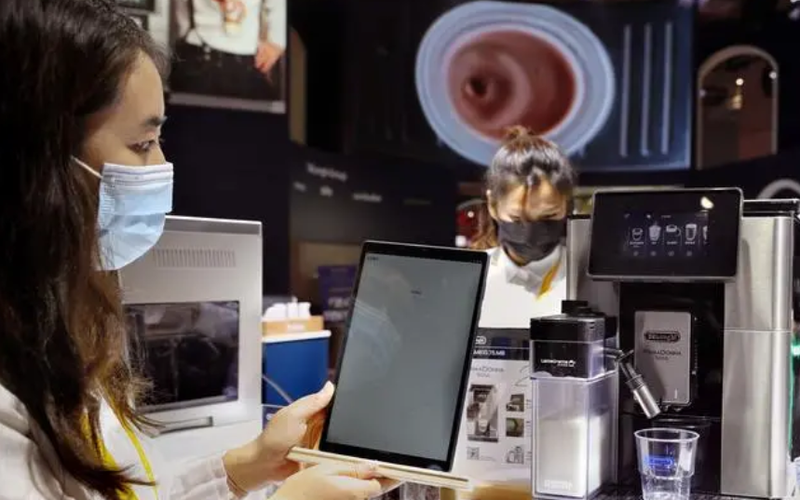 ▲ "Green+Smart" has become a new trend in home appliances. Figure/Xinhua News Agency
Of course, times have changed, and this trade-in is different from the last one in many ways. In July 2022, the Notice of the Ministry of Commerce and other 13 departments on Several Measures to Promote the Consumption of Green Smart Home Appliances set off a new wave of home appliances going to the countryside. The government work report of the two sessions in 2023 also emphasized: continue to support the consumption of new energy vehicles and encourage local governments to carry out green smart home appliances to the countryside and trade in old ones.
In recent years, China’s new energy industry has developed rapidly, and it is in the forefront of the world in many technologies, products, talents, management and brands. Therefore, promoting the trade-in of the consumer market is actually complementary to the industrial transformation and upgrading. The market share of green, digital and intelligent products and equipment is increasing day by day, which has its own market rules. At this time, it is also in line with the logic of economic development to propose equipment renewal.
Private enterprises should be better involved.
At the same time, it should also be noted that the last trade-in was more government-led and financial support, and this time it was carried out in a government-led and enterprise-led way. The meeting also stressed that it is necessary to adhere to the market-oriented, government guidance, encourage the advanced, eliminate the backward, adhere to the standard guidance, and improve in an orderly manner.
The market-oriented tone of making enterprises "the leading role" can make the docking of supply and demand more efficient, but it should also be noted that the actual effect of some measures still needs to be improved after the lack of financial support in the past two years.
Enterprise-led gives some enterprises opportunities, but also brings some operational pressures, especially for a large number of private enterprises, which also bear the heavy responsibility of ensuring employment. At this time, it may be necessary to give more support to enterprises, especially private enterprises, to complete the liquidity expansion in counter-cyclical and cross-cyclical hedging and help them participate better.
At the same time, it is also necessary at this time to build a good and friendly business environment, so that enterprises of all types can truly develop in a market-oriented and rule-based environment, and give more relaxed and inclusive policy conditions, rest and be cautious in punishment. Therefore, whether the future fiscal policy can further exert its strength and give more subsidies and support in promoting consumption is also the market expectation.
Of course, high-quality development also needs to pay more attention to improving quality and efficiency. The meeting pointed out that logistics is the "tendon" of the real economy, connecting production and consumption, domestic trade and foreign trade, and it is necessary to effectively reduce the logistics cost of the whole society, enhance the core competitiveness of the industry, and improve the efficiency of economic operation.
The logistics industry is connected with production at one end and consumption at the other end, which is an important link to smooth the national economic cycle. In recent years, China’s logistics system construction has made great progress, but relatively speaking, the logistics cost is still high, and there are also some problems, such as insufficient integration of logistics and industrial chain supply chain, high storage and management operation costs, inconsistent rules of logistics market, high institutional transaction costs and so on.
Institutional transaction costs bring about the problems of market disunity, unsmooth circulation and uneconomical consumption, which require the relevant departments to further implement the details of unifying the big market. It is particularly necessary to cancel and adjust some unreasonable fines, reduce pilot fees in coastal ports, and reduce cargo port fees and truck tolls in stages.
The expansion and upgrading of residents’ consumption has always been the common hope of macro-economy and micro-economy, which is not only necessary for national development, but also necessary for people’s livelihood protection. At this moment, in the face of many international uncertainties, we must do our own thing well, and safeguarding people’s livelihood and boosting domestic demand are important tasks.
In this process, in addition to further improving the institutional guarantee of smooth marketization and rule of law, reducing institutional transaction costs, improving quality and efficiency, we also need tolerance and support at the policy level. Of course, the strength of monetary and fiscal policies is also essential.
Written by/Wan Zhe (Professor of Beijing Normal University, Executive Director of China Modern Finance Society)
Editor/Ma Xiaolong
Proofreading/Wu Xingfa