How to adjust the limit of bank payment? How do these limits affect the convenience of users’ transactions?

In modern financial transactions, the adjustment of bank payment limit is a key link, which not only affects the convenience of users’ transactions, but also directly affects the security and liquidity of funds. Understanding how to adjust these limits and their specific impact on users’ trading experience is very important for everyone involved in financial activities.

First of all, the adjustment of bank payment limit usually involves two main aspects: single transaction limit and daily cumulative transaction limit. These limits are set to protect the safety of users’ funds and prevent unauthorized large transactions. However, for users who need to make large transactions, these limits may become obstacles to transactions.

In order to adjust the limit of bank payment, users usually need to apply through the official channels of the bank. This may include online banking systems, mobile banking applications or going directly to the bank counter. During the application process, the user may need to provide identification, a description of the purpose of the transaction and possibly other relevant documents. The bank will decide whether to approve the adjustment of the limit according to the user’s risk assessment and transaction history.

These limits have a direct impact on the convenience of users’ transactions. For example, if a user needs to trade a large amount of futures, but the bank’s single trading limit is low, then the user may need to trade in several times, which not only increases the time cost of trading, but also may affect the final effect of trading because of market fluctuations.

The following is a table showing the influence of different bank payment limits on users’ transaction convenience:

bank Single transaction limit Daily cumulative trading limit affect Bank a 50,000 yuan 100,000 yuan Suitable for small transactions, large transactions need to be carried out several times. Bank b 200,000 yuan 500,000 yuan Suitable for medium-sized transactions, large-value transactions still need to pay attention to the limit. Bank c 500,000 yuan 1 million yuan Suitable for large transactions, with high transaction convenience.

As can be seen from the table, the payment limit settings of different banks are quite different, which directly affects the user’s trading experience. For futures traders, choosing a bank with higher payment limit can significantly improve the convenience and efficiency of trading.

In addition, the adjustment of bank payment limit may also be affected by regulatory policies. For example, in some special periods, banks may temporarily increase or decrease the payment limit to cope with market fluctuations or security risks. Therefore, users should also pay attention to relevant policy changes when adjusting the payment limit.

In a word, the adjustment of bank payment limit is a complicated but necessary process, which is directly related to the convenience of users’ transactions and the safety of funds. By understanding and reasonably using these limits, users can better manage their financial activities and ensure the smooth progress of transactions.

(Editor in charge: difference extension)

[Disclaimer] This article only represents the author’s own views and has nothing to do with Hexun. Hexun.com is neutral about the statements and opinions in this article, and does not provide any express or implied guarantee for the accuracy, reliability or completeness of the contents. Readers are requested for reference only, and please take full responsibility. Email: news_center@staff.hexun.com.

Guidelines for factor-based trial of equity transfer dispute cases (for Trial Implementation)

editorial comment/note

In order to improve the thinking ability of commercial trials in Shanghai No.2 Intermediate People’s Court and the courts in its jurisdiction, improve the quality and effectiveness of commercial trials, and improve the unified mechanism of applying laws, the Commercial Court of Shanghai No.2 Intermediate People’s Court conducted a typological investigation and exploration on the application of factor-based trial methods in some commercial cases. In this issue, "Guidelines for Factor-based Trial of Equity Transfer Disputes (Trial)" was published, which was jointly written by the Commercial Court of Shanghai No.2 Intermediate People’s Court and the Commercial Court of Huangpu Court, and was discussed and passed at the meeting of professional judges of the Commercial Court of Shanghai No.2 Intermediate People’s Court, providing reference for commercial trials of courts in the jurisdiction.

Common trial elements and their review points

Equity transfer, a changes in equity based on legal acts, is a private law act in which the transferring shareholder and the transferee conclude an equity transfer contract and transfer the equity. Articles 71 to 75 of Chapter III of People’s Republic of China (PRC) Company Law (hereinafter referred to as the Company Law) make special provisions on this. Equity transfer contracts have the characteristics of general civil contracts. The general provisions on the validity of civil legal acts (invalid, undetermined and revocable) and their consequences in the General Part of People’s Republic of China (PRC) Civil Code (hereinafter referred to as the Civil Code) and the provisions on the validity of contracts in the Contract Part of the Civil Code are applicable to equity transfer contracts. The provisions on the conclusion, performance, liability for breach of contract, and dissolution of the contract in the Civil Code are also applicable to the equity transfer contract. The equity transfer contract is an unnamed contract, the subject matter of which is equity, and it is a special sales contract. According to the provisions of Articles 467 and 646 of the Civil Code, in the absence of other laws, disputes over equity transfer can be resolved by referring to the relevant provisions of applicable sales contracts. These Guidelines closely follow the right attribute of equity, and focus on the typical problems that distinguish equity transfer contracts from sales contracts, including: the relationship between state supervision and contracts, the relationship between restrictions on equity transfer by laws or articles of association, the relationship between company capital system and contracts, etc., and collect information on case elements, sort out specific review points, and use them as reference for similar cases. It should be noted that these guidelines mainly focus on the review points in the trial of disputes over equity transfer contracts.If it involves the transfer of equity as a disciplinary action, special instructions will be made. In addition, this guideline does not involve disputes over equity transfer contracts of financial institutions and share transfer contracts of listed companies.

one

Ordinary equity transfer contract

Obtaining complete equity based on equity transfer is a gradual process, which first occurs between the transferor and the transferee, then between the transferee and the company, and finally between the third party (including the transferor’s creditors, transferee’s creditors, company creditors, etc.) and the company. When the equity appears purely as a target, the contractual rights and obligations mainly involve both parties to the equity transfer. Such disputes may be more about whether the contract law is fully fulfilled or whether there are problems such as dissolution after the contract purpose cannot be achieved. The determination of the rights and obligations of both parties should follow the true meaning of the parties. Usually, after the equity transfer contract comes into effect, the main payment obligations of both parties to the equity transfer contract are that the transferor transfers the equity and the transferee pays the equity transfer money.

1. Obligations of the assignor

As for the assignor’s obligations, the reasons for the dispute between the two parties or the assignee’s defense are mainly as follows: first, the restrictions on equity transfer in the articles of association have not been observed, the consent of other shareholders has not been obtained or clearly obtained, or the preemptive right of other shareholders has not been respected. Second, the company has not completed the internal procedures, including the changes recorded in the register of shareholders, the failure to issue a capital contribution certificate, and the failure to amend the articles of association. Third, the change registration of shareholders in the company registration authority has not been completed. The main points of the review of the first point have been sorted out in part (b). Regarding the second and third points mentioned above, although there is great controversy about the changes in equity model in theory and practice, for both parties to the equity transfer contract, how to determine the transferor’s obligations and whether to complete the main payment obligations should respect the agreement of both parties and seek the true meaning. The main points of review are as follows:

① If it is stipulated in the contract that the transferor shall cooperate with the target company to complete the renewal of the investment certificate, change the records in the register of shareholders, modify the articles of association and change the company registration, the transferor shall fulfill the corresponding obligations according to the contract. If the assignor fails to perform the above obligations, the assignee may request to order the assignor to perform the corresponding obligations. If the assignor refuses to perform, the assignee may exercise the right of rescission according to law.

(2) If there is no explicit agreement in the contract, it shall be determined whether the contents agreed by both parties include that the transferor shall ensure that the transferee’s shareholder status is confirmed by the company, and whether it includes the obligation to ensure that the company completes the registration of the transferee as a shareholder. After confirming the assignor’s obligations, it is further judged whether the assignor has breached the contract or not, and whether it constitutes a fundamental breach of contract, which leads to the failure to achieve the contract purpose.

③ Unless otherwise agreed in the contract, the signing of the contract presumes that the transferor agrees to transfer the equity to the transferee, and the transferor shall inform the company of the equity transfer. If the transferor fails to inform the company of the transfer in time, the transferee may request the transferor to perform the corresponding obligations.

④ According to Article 73 of the Company Law, it is the legal obligation of the company to record the transferee in the register of shareholders, issue a capital contribution certificate, modify the shareholders’ clauses in the Articles of Association, and register the change of shareholders at the company registration authority, which is not an obligation under the equity transfer contract. If the transferor has notified the company of the equity transfer, but the company fails to complete the above changes in time, the transferee has the right to require the company to fulfill its legal obligations and claim compensation for losses.

⑤ Even if the company has not registered the change of company, if the transferee has participated in the shareholders’ meeting as a shareholder and received dividends, and there are no other special provisions in the equity transfer contract, and the transferor has not refused to cooperate, if the transferee refuses to pay the equity transfer fee just because the company has not registered the change, its claim will be difficult to support. You can explain to the transferee that you can sue the company separately.

2. Obligations of the assignee

2.1 Review points of equity transfer payment

In the equity transfer contract, the transferee’s main payment obligation is to pay the equity transfer money, and the key points of review are as follows:

① Determination of equity transfer payment. Disputes over the amount of equity transfer money mostly occur when the equity transfer contract kept by the parties and the equity transfer contract filed by the registration authority have different stipulations on equity transfer money. This kind of "yin-yang contract" is mostly caused by the parties’ tax avoidance and tax evasion. In this case, we should explore the true meaning of both parties in combination with the negotiation process, contract agreement and contract performance, and determine which contract or the price in which contract reflects the true meaning of both parties. It is forbidden for judges to determine the price by themselves according to the company’s assets and financial information, and according to the "fairness principle".

(2) On the exercise of the right of defense for simultaneous performance. If the transferee refuses to pay the equity transfer payment on the grounds that the transferor has not delivered the company license and account books, it should pay attention to examining whether the equity transfer contract has a corresponding agreement on the transferor’s obligation to deliver the company license and account books, and whether this obligation corresponds to the obligation to pay the equity transfer payment.

2.2 One party requests to confirm that the equity transfer contract is invalid or cancel the equity transfer contract because of dissatisfaction with equity transfer price.

Equity is a special "commodity". There is no unified market for the equity of a limited liability company, and its value is difficult to determine. Besides the company’s assets, the company’s cash flow is also an important factor for both parties to determine the price. For both parties to the transaction, the determination of equity transfer price is the "subjective" judgment of the commercial subject. In addition, the company’s industry and industry development will also have an impact on the equity value. In addition, changes in equity involves many links, and the parties may go back on their word during this period, which is also an important reason for the frequent disputes over equity transfer. After the signing of the equity transfer contract, if one party requests to confirm that the equity transfer contract is invalid or request to cancel the contract because of disagreement with the equity price, the main points of the review are as follows:

(1) the price factor itself is not the reason for determining that the contract is invalid. Whether the contract is invalid or not should be determined according to the relevant provisions of the Civil Code on the invalidity of legal acts.

(2) After the signing of the equity transfer contract, if one party requests to cancel the equity transfer contract on the grounds of major misunderstanding, obviously unfair, fraud, etc. because of disagreement with the equity price, it shall be reviewed according to the relevant provisions of the Civil Code on the cancellation of legal acts and combined with specific cases.

(3) If there is no such situation, the parties to the contract should not support their objections to the effectiveness of the contract just because they have objections to the equity price or the equity price changes greatly, which is the risk that the parties should bear. Even if there is a change of circumstances, it will be handled by the court at the request of the parties according to the legal provisions and specific circumstances under the premise that the equity transfer contract is valid.

3. Review of other contract disputes.

3.1 Equity transfer contract for shareholders who have not completed the capital contribution period, shareholders who have not fulfilled or fully fulfilled their capital contribution obligations, and shareholders who have withdrawn their capital contribution.

(1) The shareholders who have not completed the capital contribution period transfer their shares to the outside world, and the main points of review are as follows:

(1) Shareholders who have not completed the capital contribution period can still transfer their equity according to law, and the corresponding equity transfer contract shall be deemed valid if there are no other reasons that affect the effectiveness of the contract.

(2) The rights and obligations of the transferor and the transferee shall be determined according to the stipulations of the equity transfer contract, but the obligations of both parties to the company and its creditors shall be determined according to relevant laws. It is worth noting that at present, the Company Law and judicial interpretation do not directly stipulate the obligations of the transferor in this case, but the first paragraph of Article 88 of the Second Revised Draft of the Company Law stipulates this situation: "If a shareholder transfers the equity that has subscribed for capital contribution but has not yet paid the capital contribution period, the transferee shall bear the obligation to pay the capital contribution; If the transferee fails to pay the capital contribution in full and on time, the transferor shall bear supplementary responsibilities for the capital contribution that the transferee fails to pay on time. " In the trial practice, we should continue to pay attention to the revision of the Company Law. Before the revision of the Company Law is completed, we can handle such disputes with reference to this spirit.

(2) Shareholders who have not fulfilled or not fully fulfilled their capital contribution obligations transfer their shares to the outside world. The main points of review are as follows:

① Shareholders who fail to fulfill or fully fulfill their capital contribution obligations transfer their equity to the outside world, and the validity of the corresponding equity transfer contract is determined as above.

(2) The rights and obligations of the transferor and the transferee shall be determined according to the agreement on equity transfer. According to Article 18 of the Supreme People’s Court’s Provisions on Several Issues Concerning the Application of the Company Law of People’s Republic of China (PRC) (hereinafter referred to as Interpretation III of the Company Law), if a shareholder fails to perform or fails to fully perform his capital contribution obligations, the transferee knows or should know that the company has the right to request the shareholder to perform his capital contribution obligations and the transferee is jointly and severally liable for it, and the company’s creditors have the right to request the shareholder with capital contribution obligations to bear supplementary liability for the unpaid part of the company’s debts within the scope of principal and interest, and the transferee shall bear joint liability. Paragraph 2 of Article 88 of the Second Revised Draft of the Company Law also stipulates that "if a shareholder fails to pay the capital contribution in full on schedule or the actual price of non-monetary property as capital contribution is significantly lower than the subscribed capital contribution, if the transferee knows or should know the above situation, he shall be jointly and severally liable with the shareholder within the scope of insufficient capital contribution."

(3) Withdrawing the capital contribution shareholders to transfer their shares to the outside world, and the main points of review are as follows:

(1) If the shareholder who withdraws the capital contribution transfers the equity to the outside world, the validity of the corresponding equity transfer contract shall be determined as above.

(2) The rights and obligations of the transferor and the transferee shall be determined according to the agreement on equity transfer, but the obligations of both parties to the company and its creditors shall be determined according to relevant laws. At present, the Company Law and judicial interpretation do not directly stipulate the assignee’s obligations in this case. If the withdrawal of capital contribution is understood as an infringement of the company’s property rights, it seems that there is no legal basis for requiring the assignee to bear joint liability for the relevant responsibilities of the assignor without assisting the assignor to withdraw capital contribution. However, if the transferor withdraws the capital contribution immediately after the capital contribution, the situation is not much different from that of the non-capital contribution. If the transferee knows or should know of the above situation, it can refer to the provisions of Article 18 of Interpretation III of the Company Law.

3.2 The effectiveness of the equity transfer contract during the existence of the husband-wife relationship

This kind of cases mostly occur at the stage of divorce proceedings between husband and wife or before they are ready to file divorce proceedings. Plaintiffs usually regard the equity as the common property of husband and wife, and take their spouses and equity transferees as defendants on the grounds that their spouses and equity transferees are not approved by the plaintiff, that is, both parties to the equity transfer contract are told to the court and request to confirm that the equity transfer contract is invalid. Key points for review of such cases:

(1) the equity acquired during the marriage relationship or the equity invested by the husband and wife’s joint property is not necessarily the joint equity of the husband and wife. The ownership of equity and the determination of shareholders’ qualifications should be determined according to the articles of association, the register of shareholders and the company registration.

② Shareholders have the right to dispose of foreign transfer of equity without the consent of their spouses.

③ The corresponding equity transfer contract shall be deemed valid if there are no other reasons that affect the effectiveness of the contract.

3.3 Equity transfer contract for nominal shareholders to transfer equity under the condition of holding equity on behalf of others.

Article 25 of Interpretation III of the Company Law stipulates, "If a nominal shareholder transfers, pledges or disposes of the equity registered in his name, and the actual investor requests that the disposition of the equity is invalid on the grounds that he has actual rights over the equity, the people’s court may refer to the provisions of Article 311 of the Civil Code. If the nominal shareholder disposes of the equity and causes the actual investor to lose money, and the actual investor requests the nominal shareholder to bear the liability for compensation, the people’s court shall support it. " In practice, stock holding can be divided into two situations: complete anonymity and incomplete anonymity. The main points of review are as follows:

(1) completely anonymous. In this case, for the company, other shareholders and the transferee, the investor is a shareholder and cannot be called a "nominal shareholder". The investor has the right to dispose of the equity transfer, and the equity transfer contract is valid. changes in equity is no different from ordinary equity transfer, so there is no room for the application of Article 25 of Interpretation III of the Company Law.

② Incomplete anonymity. In this case, within the company, all other shareholders admit that the actual investor is a shareholder, and the nominal shareholder is not a shareholder in essence. Therefore, the nominal shareholder’s unauthorized transfer of equity constitutes no right to dispose of it. In this case, as a burden, the equity transfer contract shall be deemed valid unless there are other circumstances that affect the effectiveness of the contract. For the effectiveness of punishment, we can refer to the provisions of Article 311th of the Civil Code on bona fide acquisition.

two

Restrictions on equity transfer by laws or articles of association and equity transfer contract

The object of the equity transfer contract is equity, and equity, as a right facing the company organization, should be adjusted by the relevant legal norms of the company organization in the Company Law. The restrictions on equity transfer in the Company Law and other laws or articles of association will inevitably have an impact on the equity transfer contract.

1. The preemptive right of other shareholders and the equity transfer contract

1.1 Shareholders’ preemptive right

1.1.1 "Company Law" on the provisions of shareholders’ preemptive right

The Company Law restricts the equity transfer of a limited liability company. If the transferring shareholder transfers the equity to the outside world, other shareholders shall enjoy the preemptive right under the same conditions.

In view of the fact that the exercise of the preemptive right of other shareholders and the remedies after the preemptive right is infringed will have an impact on the equity transfer contract, it is necessary to sort out the main points of the review of the exercise of the preemptive right of shareholders first:

(1) The subject and conditions for exercising the preemptive right. According to the second paragraph of Article 71 of the Company Law, specifically:

① Other shareholders in a limited liability company except the transferring shareholder.

(2) transfer shareholders to transfer equity to people other than shareholders.

③ Where there are other provisions in the articles of association on equity transfer, such provisions shall prevail.

(2) The consent right of other shareholders (first notice). According to the provisions of Paragraph 2 of Article 71 of the Company Law and Paragraph 1 of Article 17 and Article 22 of Interpretation 4 of the Company Law, shareholders of a limited liability company shall notify other shareholders when transferring their equity to persons other than shareholders, specifically:

(1) notification method. The transferring shareholder may be notified in writing or in other reasonable ways to ensure knowledge. According to the provisions of Article 137 of the Civil Code, the notice shall come into effect when other shareholders know its contents. If it is made in a non-dialogue way, it will take effect when it reaches other shareholders; If the non-dialogue notice is in the form of data message, if other shareholders designate a specific system to receive the data message, the data message will take effect when it enters the specific system; if no specific system is designated, other shareholders know or should know that the data message will take effect when it enters its system. The notification obligor shall be the transferring shareholder.

② Where the equity is transferred to a person other than the shareholders through auction, the method of "written notice" and "notice" shall be determined according to the legal provisions in Item ① above and the laws and regulations related to auction. When transferring state-owned shares in a legally established property rights exchange, the way of "written notice" and "notice" can refer to the trading rules of the property rights exchange.

③ Proportion of agreed transfer. It must be agreed by more than half of other shareholders, which is determined by "number of shareholders" here, not by voting rights, and the company is not allowed to relax the conditions of consent in its articles of association.

(4) the period of consent and the change of disagreement and consent. Other shareholders shall reply within 30 days from the date of receiving the written notice. If they fail to reply, they shall be deemed to have agreed to the transfer. Shareholders who do not agree to the transfer shall purchase the transferred equity; Do not buy, as agreed to transfer.

(3) The preemptive right of other shareholders (second notice). According to the provisions of Paragraph 3 of Article 71 of the Company Law and Paragraph 2 and Paragraph 3 of Article 17 of Interpretation 4 of the Company Law, Article 18, Article 19 and Article 22, other shareholders may exercise the preemptive right under the same conditions:

(1) the way of notification. Shareholders may notify in writing or in other reasonable ways to ensure knowledge.

② The same conditions. When judging whether it meets the "equal conditions", we should consider the quantity, price, payment method and time limit of the transferred equity. The same conditions are not limited to specific fixed factors, as long as all kinds of factors that are reasonably valued by the transferor and can have a substantial impact on the transaction are listed here, such as the obligation of subordinate payment that cannot be replaced or can not be valued by money, the commitment to employee placement, the commitment to debt commitment, equity swap, etc.

(3) Where the equity is transferred to a person other than a shareholder by auction, the "written notice", "notice" and the determination of "equivalent conditions" shall be determined according to relevant laws and judicial interpretations. When transferring state-owned shares in a legally established property rights exchange, the methods of "written notice" and "notice" and the determination of "equivalent conditions" can refer to the trading rules of the property rights exchange.

(4) other shareholders exercise their rights within a reasonable period of time. Shareholders who claim the priority to purchase the transferred equity shall, after receiving the notice, make a purchase request within the exercise period stipulated in the articles of association. If the exercise period is not specified in the Articles of Association or is unclear, the period specified in the notice shall prevail; if the period specified in the notice is shorter than 30 days or the exercise period is unclear, the exercise period shall be 30 days.

(4) Two-in-one notification procedure. In practice, after the transferring shareholder and the potential transferee negotiate the terms of the contract or the basic transaction conditions, the two notices are merged into one notice, which should also be deemed to be in compliance with the relevant provisions of the law. If other shareholders are willing to accept the contract on the same terms, both parties can directly conclude the contract. We should also pay attention to the relevant provisions of the revised company law. At present, Article 84 of the Revised Draft of the Company Law only stipulates one notice, that is, "if a shareholder transfers his equity to a person other than a shareholder, he shall notify other shareholders in writing, and other shareholders shall have the preemptive right under the same conditions".

(5) Transfer the shareholders’ right of estoppel. According to Article 20 of Interpretation 4 of the Company Law, the transferring shareholder has the right to go back on his word:

(1) Unless otherwise stipulated in the Articles of Association, if the transferring shareholder does not agree to transfer the equity after other shareholders claim the preemptive right, the claim of preemptive right of other shareholders shall not be supported.

(2) the right of estoppel shall not be abused.

③ If the transferring shareholder goes back on his word, other shareholders may claim that the transferring shareholder should compensate his reasonable losses.

(6) Remedies for infringement of preemptive right. According to Article 21 of Interpretation 4 of the Company Law, the remedies for infringement of preemptive right include claiming priority and damages, as follows:

(1) advocate the realization of preemptive right. Where the transferring shareholder fails to seek the opinions of other shareholders on the transfer of its equity, or damages the preemptive right of other shareholders by means of fraud or malicious collusion, other shareholders may claim to purchase the transferred equity under the same conditions, but they shall do so within 30 days from the date when they know or should know the same conditions for exercising the preemptive right, except that more than one year has passed since the date of registration of equity change. These "30 days" and "one year" are the same period, and the provisions of suspension, interruption and extension are not applicable.

(2) claim damages. If the infringed shareholder is unable to exercise the preemptive right for reasons other than his own, he may claim damages.

(3) Other shareholders only request to confirm the equity transfer contract and the validity of changes in equity, and do not advocate to purchase the transferred equity under the same conditions at the same time, so their application shall not be supported, except that other shareholders cannot exercise the preemptive right due to their own reasons, and claim damages.

1.1.2 Special Provisions on Shareholders’ Right of Consent and Preemptive Right of Foreign-invested Enterprises

Articles 11 and 12 of the Provisions of the Supreme People’s Court on Several Issues Concerning the Trial of Disputes in Foreign-invested Enterprises (I) stipulate the validity of the equity transfer contract when the shareholders’ consent rights and preemptive rights of foreign-invested enterprises are infringed, which is different from the relevant provisions of the Company Law of People’s Republic of China (PRC) (hereinafter referred to as the Company Law) and the Provisions of the Supreme People’s Court on Several Issues Concerning the Application of the Company Law of People’s Republic of China (PRC) (IV) (hereinafter referred to as the Company Law Interpretation IV), and should be paid attention to.

① If a shareholder of a foreign-invested enterprise transfers all or part of its equity to a third party other than the shareholder, it shall be unanimously agreed by other shareholders, who have the right to request cancellation of the equity transfer contract on the grounds that they have not obtained their consent. Exceptions: firstly, there is evidence that other shareholders have agreed; secondly, the transferor has given a written notice on the transfer of equity, and other shareholders have not given a reply within 30 days from the date of receiving the written notice; thirdly, other shareholders do not agree to the transfer and do not buy the transferred equity.

② If a shareholder of a foreign-invested enterprise transfers all or part of its equity to a third party other than the shareholder, other shareholders have the right to request cancellation of the equity transfer contract on the grounds that the equity transfer infringes on their preemptive right. Unless other shareholders know or should know that they have not claimed the preemptive right within one year from the date of signing the equity transfer contract.

(3) If the transferor or transferee requests that the equity transfer contract is invalid on the grounds of infringing the preemptive right of other shareholders, it shall not be supported.

1.2 Infringe on the preemptive right of other shareholders and the performance of the equity transfer contract

The exercise of the shareholders’ preemptive right and the remedies after the infringement of the preemptive right are often related to the performance of the equity transfer contract between the transferring shareholders and the transferee. If the shareholders’ preemptive right is infringed, they can claim to exercise the preemptive right, but the equity transfer contract between the transferring shareholders and the transferee cannot be continued. If the shareholders’ preemptive right is infringed, they can only claim damages, and the equity transfer contract between the transferring shareholders and the transferee may not be affected. According to the contents of Article 9 of the Minutes of the Ninth People’s Congress, the specific review points are as follows:

① The equity transfer contract between the transferring shareholder and the transferee shall be deemed valid if there are no other reasons that affect the effectiveness of the contract.

② The exercise of preemptive right by other shareholders only leads to the transferee’s inability to request the transferring shareholder to continue to perform the equity transfer contract, that is, it only affects the punishment behavior. Although the transferee other than the shareholder’s request to continue to perform the equity transfer contract cannot be supported, it does not affect its request to the transferring shareholder to bear the corresponding liability for breach of contract, and it can also request to terminate the contract on the grounds that the contract purpose cannot be achieved.

(3) Even if the transferring shareholder has completed the company change registration without notifying other shareholders after signing the equity transfer contract with the transferee, it should be recognized that the equity transfer contract between the transferring shareholder and the transferee implies the following obligations, that is, when other shareholders exercise the preemptive right according to law, the transferee should cooperate to re-transfer the equity to the transferring shareholder, including cooperating to handle the corresponding change registration.

2. Equity transfer contract under the condition that the company’s articles of association restrict equity transfer.

Based on the closeness and humanity of a limited liability company, Article 71 of the Company Law stipulates that "if there are other provisions on equity transfer in the articles of association, those provisions shall prevail". If the restrictions on equity transfer in the articles of association are not invalid, the effectiveness and performance of the equity transfer contract that violates the restrictions on equity transfer in the articles of association may cause disputes among the parties. The main points of review are as follows:

① The Articles of Association is an agreement on internal autonomy of the company, not a mandatory provision of laws and regulations. Violation of the Articles of Association does not necessarily lead to the invalidity of the equity transfer contract. If there are no other reasons that affect the effectiveness of the contract, it shall be deemed valid.

(2) If the equity transfer violates the company’s articles of association, so that the transferee cannot obtain the equity, the transferee may claim the liability for breach of contract from the transferring shareholder, or terminate the contract on the grounds that the purpose of the contract cannot be achieved.

③ If the transferee is aware of the relevant restrictions in the Articles of Association when signing the contract, the corresponding losses shall be borne by him.

3. Share transfer contracts that violate legal restrictions.

The shares held by the shareholders of a joint-stock company can be transferred according to law. However, for the shareholders with special status and Dong Jiangao, Article 141 of the Company Law still has certain restrictions on their share transfer. The effectiveness and performance of the equity transfer contract that violates the legal restrictions may cause disputes among the parties. The key points of the case review are as follows:

3.1 In view of the restrictions on the transfer of shares by promoters in the Company Law,

① The shares of the Company held by the promoters shall not be transferred within one year from the date of establishment of the Company. In addition, the shares issued before the company’s public offering of shares shall not be transferred within one year from the date when the company’s shares are listed and traded on the stock exchange.

(2) If the promoters transfer shares within the restricted period stipulated by law, if the equity transfer contract is a contract with a term or conditions, it shall be deemed valid if there are no other reasons that affect the effectiveness of the contract. Both parties have the right to request the other party to perform the contract according to the contract from the date when the term expires or the conditions are fulfilled.

(3) When the promoters transfer their shares within the restricted sale period stipulated by law, they may determine that the disciplinary action is invalid if the contract is deemed to be valid. The transferee should be aware of the relevant legal restrictions before signing the contract, and the corresponding losses should be borne by himself. The signing of the share transfer agreement between the sponsor and the transferee does not exempt them from their legal responsibilities, including the obligations of the sponsor as a shareholder of the company.

3.2 In view of the restrictions imposed by the Company Law on directors, supervisors and senior managers,

① During his term of office, the company’s Dong Jiangao shall not transfer more than 25% of the total shares of the company he holds, and the shares of the company he holds shall not be transferred within one year from the date of listing and trading of the company’s shares. Within six months after leaving his post, he shall not transfer his shares in the Company.

② The review points of the effectiveness of share transfer contract and liability for breach of contract are the same as 3.1.

three

State supervision and equity transfer contract

In the trial of equity transfer disputes, we should first pay attention to the effectiveness of the contract, and state supervision has an important impact on the effectiveness and performance of the contract.

1. State supervision and effectiveness of equity transfer contract

1.1 Equity transfer of state-owned enterprises

The transfer of state-owned shares shall follow the principles of equal compensation, openness, fairness and justice, so as to prevent the loss of state-owned assets and damage the legitimate rights and interests of all parties to the transaction. Articles 51 to 57 of the State-owned Assets Transfer Part of Section V of the State-owned Assets Law of People’s Republic of China (PRC) Municipality make relevant provisions on the approval, evaluation and trading place of the equity transfer of state-owned holding and shareholding companies.

(1) The influence of the approval procedure on the equity transfer contract of state-owned enterprises. Attention should be paid to whether the equity transfer of state-owned enterprises should be approved, and the main points of the review are as follows:

(1) if the relevant approval procedures affect the effectiveness of the contract without approval, according to the provisions of Article 502 of the Civil Code, the contract shall be deemed to be ineffective without approval. If the parties request to confirm that the contract is invalid on this ground, it will not be supported.

② If the aforesaid equity transfer contract is deemed to be ineffective because it has not been approved, it will not affect the effectiveness of the clauses in the contract in which the parties perform the obligation of approval and the relevant clauses set due to the obligation of approval.

(3) If the relevant approval procedures do not affect the effectiveness of the contract and are not approved, it will only affect the effectiveness of disciplinary actions or have adverse consequences in administrative supervision according to relevant laws and regulations. If there are no other reasons that affect the effectiveness of the contract, the equity transfer contract shall be deemed to be valid.

Specifically, according to the provisions of Article 25 of the Interim Measures for the Administration of the Transfer of State-owned Property Rights of Enterprises, if the transfer of state-owned property rights of enterprises causes the state to lose its holding position, it shall be reported to the people’s government at the same level for approval. According to the provisions of Article 26, the invested enterprise shall report to the state-owned assets supervision and administration institution at the same level for countersigning with the financial department for approval when deciding on the transfer of major state-owned property rights of its important subsidiaries. If it involves the examination and approval of the government’s social and public management, it shall be reported to the relevant government departments for examination and approval in advance. According to the provisions of Article 32, if the above approval procedures are not fulfilled, the state-owned assets supervision and administration institution or the relevant approval institution for the transfer of state-owned property rights of enterprises shall require the transferor to terminate the transfer of property rights, and if necessary, bring a lawsuit to the people’s court according to law to confirm that the transfer is invalid. Accordingly, if the above situation is not approved, the relevant equity transfer contract will not take effect. Therefore, for the equity transfer of state-owned enterprises, attention should be paid to examining whether there are the above situations or other situations stipulated by law that require the approval of the party to take effect.

(2) Other circumstances that affect the effectiveness of the contract. According to the provisions of Article 32 of the Interim Measures for the Administration of the Transfer of State-owned Property Rights of Enterprises, in the process of the transfer of state-owned shares, the state-owned assets supervision and administration institution or the relevant approval institution for the transfer of state-owned property rights of enterprises shall require the transferor to terminate the transfer of property rights, and if necessary, bring a lawsuit to the people’s court according to law to confirm that the transfer is invalid. In case that the violation of the relevant provisions of the State-owned Assets Law of People’s Republic of China (PRC) on evaluation and trading places causes damage to the national interests, it belongs to the case that the provisions of Article 153 of the Civil Code violate the mandatory provisions of the law, and the relevant contracts shall be deemed invalid. The main points of the review are as follows:

(1) for the transfer of state-owned shares, attention should be paid to whether the review and evaluation procedures conform to the provisions of the Law of People’s Republic of China (PRC) on State-owned Assets of Enterprises.

(2) For the transfer of state-owned shares, attention should be paid to examining whether the trading place complies with the provisions of the Law of People’s Republic of China (PRC) on State-owned Assets of Enterprises.

1.2 Equity transfer of foreign investment

(1) The influence of the approval procedure on the equity transfer contract with foreign investment. According to the provisions of the Supreme People’s Court Municipality on Several Issues Concerning the Trial of Dispute Cases of Foreign-invested Enterprises (I), the main points of the review are as follows:

(1) If the equity transfer contract with foreign investment shall come into effect after being approved by the examination and approval authorities of foreign-invested enterprises according to laws and regulations, it shall come into effect as of the date of approval. Without approval, it shall be deemed that the contract has not come into effect. If the parties request to confirm that the contract is invalid on this ground, it will not be supported.

(2) If the equity transfer contract is deemed to be ineffective because it has not been approved, it will not affect the effectiveness of the clauses in the contract that the parties perform the obligation of approval and the relevant clauses set due to the obligation of approval.

(3) If the supplementary agreement reached by the parties on matters related to foreign-invested enterprises does not constitute a major or substantial change to the approved contract, it shall not be deemed that the supplementary agreement has not taken effect on the grounds that it has not been approved by the examination and approval authority of foreign-invested enterprises. "Major or substantial changes" include: changes in registered capital, company type, business scope, business term, capital contribution subscribed by shareholders, capital contribution mode, company merger, company division and equity transfer.

(2) The influence of negative list on the effectiveness of foreign-invested equity transfer contract. Article 28 of Chapter IV Investment Management of the Foreign Investment Law of People’s Republic of China (PRC) deals with the provisions on equity transfer of foreign-invested enterprises, that is, foreign investors are not allowed to invest in the areas prohibited by the negative list of foreign investment access, and the areas restricted by the negative list of foreign investment access, and foreign investors should meet the conditions stipulated by the negative list when investing. Foreign investment in areas outside the negative list shall be managed in accordance with the principle of consistency between domestic and foreign investment. Articles 2 to 5 of the Supreme People’s Court’s Interpretation on Several Issues Concerning the Application of the Foreign Investment Law of People’s Republic of China (PRC) further clarify the influence of foreign investment-related agreements, including equity transfer contracts, according to the above provisions. The main points of review are as follows:

① Investment contracts formed in areas other than the negative list of foreign investment access need not be approved or registered.

② In the negative list, the relevant equity transfer contract in the field of prohibited investment is invalid.

③ In the field where the negative list restricts investment, the parties concerned do not meet the special management measures for restricted access, and the relevant equity transfer contract is invalid.

Matters needing attention in the trial:

① Before the effective judgment is made, the equity transfer contract is valid if the investment is prohibited or restricted from moving out of the negative list.

② If the relevant contracts were signed before the implementation of the Foreign Investment Law (January 1, 2021), and the dispute over the equity transfer contract is still in the first and second trial proceedings, the new provisions shall apply.

(3) The above provisions shall apply with reference to disputes over equity transfer related to investments in the Mainland by investors from Hong Kong, Macao and Taiwan and China citizens who have settled abroad.

2. Breach and dissolution of the equity transfer contract that fails to fulfill the obligation of approval

The equity transfer contract that must be approved by the administrative organ and come into effect, the agreement related to the obligation of approval comes into effect independently, and the breach and dissolution of such contracts are different from other equity transfer contracts that are all in effect. According to the provisions of Article 502 of the Civil Code and the contents of Articles 38, 39 and 40 of the Minutes of Civil and Commercial Trials of National Courts (hereinafter referred to as Minutes of the Ninth People’s Congress) issued in 2019, the specific review points are as follows:

(1) review of the obligation of approval and relevant breach clauses.

(1) the contract that needs to be approved by the administrative organ to take effect, if there is a special agreement on the obligation of approval and the liability for breach of contract that fails to fulfill the obligation of approval, the agreement will take effect independently.

(2) because the other party fails to perform the obligation of approval, one party has the right to request the termination of the contract and ask it to bear the corresponding liability for breach of contract stipulated in the contract.

(3) The party who undertakes the obligation of approval shall not refuse to perform the obligation of approval on the grounds that the contract has not come into effect, otherwise the other party may go through the relevant formalities by himself and claim damages for the expenses or actual losses arising therefrom.

(2) Interpretation of the obligation of approval

① If one party requests the other party to perform the main rights and obligations of the contract, it shall explain to him that the application should be changed to request to perform the obligation of approval. If a party changes the claim, it shall be supported.

(2) If the party refuses to change the claim after the explanation, it shall reject its claim, but it shall not affect it to file another lawsuit.

(3) review of the handling after the judgment has fulfilled the obligation of approval.

(1) after the court ruled that one party performed the obligation of approval, the party refused to perform it, and the other party has the right to request it to bear the liability for breach of contract after compulsory execution.

(2) one party shall perform the obligation of approval according to the judgment, and the administrative organ shall approve it, and the contract shall have full legal effect, and it shall have the right to request the other party to perform the contract. Without the approval of the administrative organ, the contract is not legally enforceable, and one party has the right to request the termination of the contract.

four

Equity transfer contract involving the transfer of company control rights and assets.

1. Equity transfer contract involving the transfer of control rights of the company

If the purpose of the equity transfer contract is for the transferee to obtain the control right of the target company, the examination elements of the transferor’s obligations, the corresponding liability for breach of contract and the termination of the contract are different from the above-mentioned ordinary equity transfer contract. While applying the relevant provisions of the Civil Code, we cannot ignore the relevant regulations of the Company Law on company organization and corporate governance.

For the equity transfer contract involving the transfer of control rights of the company, the contract usually includes the following contents: the transferor shall complete the delivery or handover of various financial documents, legal documents, company seals, business licenses, customer information, technical secret information and even personnel in the company; Distribution requirements of corporate governance power, such as re-election of the board of directors or quota allocation, and change of legal representative; The disclosure of the debts of the target company and the relevant commitments and guarantee clauses.

To some extent, this kind of contract dispute is not a simple transaction contract, but has the attribute of organization contract. The main points of review are as follows:

① Whether the agreement of the equity transfer contract conflicts with the relevant provisions of the Company Law and the articles of association.

(2) The obligations of the transferor of such contracts are not limited to notifying the company and assisting in handling all kinds of changes, but may also include ensuring that the company completes the corresponding change registration, as well as other contractual obligations such as license, transfer of financial information, and ensuring the re-election of the board of directors. The assignor’s failure to perform the agreed obligations constitutes a breach of contract. For the termination of the contract, the purpose of the contract should be determined by combining the transaction background and contract content of both parties, and then it should be determined whether the contract purpose can not be realized if the assignor fails to perform according to the contract.

(3) If the transferor fails to disclose the company’s debts truthfully, if the contract commitment and guarantee clauses stipulate the corresponding liability for breach of contract, the parties’ agreement shall be respected; if there is no agreement, the transferor’s liability for breach of contract shall be determined according to the contract purpose of the parties and the losses of the transferee.

④ We should strictly grasp the fundamental breach of contract. With regard to the termination of the equity transfer contract, the provisions on the termination of the contract in the Contract Part of the Civil Code shall apply. For the provisions of the part of the sales contract, it should be determined whether it can be applied according to the characteristics of equity transfer, and the influence of equity transfer on the company organization law should be fully considered, and equity transfer should not be simply equated with the sale of movable property and real estate. In the trial, such disputes will face the question of whether the breach of contract by one party will inevitably lead to the dissolution of the equity transfer agreement when the control right has been transferred. Once this kind of equity transfer contract is performed, if it has actually participated in the company’s operation and management, the company has completed the change registration and invested other resources, the fundamental breach of contract should be strictly grasped, and the frequent termination of the contract may have an adverse impact on the stability of the company’s operation and management.

2. Equity transfer contract involving company assets transfer

There are the following differences between asset transfer and equity transfer: First, the subjects are different. The transferor of assets transfer is the company, and the transferor of equity transfer is the shareholder of the company. Second, the legal effect is different. The transfer of assets is the transfer of property rights. In principle, the buyer does not bear the responsibility of the seller, and the creditor of the seller (company) can only claim rights from the seller (company), but not from the asset buyer. Equity transfer is only the change of the "owner" of the company, and the original creditor’s rights and debts of the company are still borne by the company unless otherwise agreed.

In principle, in the case of equity transfer, in the absence of special agreement, the transferee cannot hold the transferor responsible for the asset defects of the target company, because in the transaction arrangement of equity transfer, the transferor only has the obligation to guarantee the authenticity of the equity, but has no obligation to ensure the authenticity of the corresponding asset value represented by the equity, which is the risk that the transferee should bear. However, if the purpose of signing the equity transfer contract (accepting 100% equity of the target company) is to obtain the assets of the company, the equity transfer agreement makes special provisions on the handover of the assets of the target company and the liability for asset defects, and the agreement of the parties should also be respected.

The main points of relevant case review are as follows:

① Distinguish between asset transfer and equity transfer. In practice, there is a phenomenon that the concepts of asset transfer and equity transfer are confused. We should confirm the transfer object according to the contract agreement, the contents of negotiation between the two parties, the signing background and the performance after signing the contract, so as to determine the nature of the contract and clarify the rights and obligations of the parties to the contract.

②100% equity transfer and asset transfer can be handled according to the same principle. If the target of equity transfer is 100% equity of the target company, there is no essential difference between equity transfer and asset transfer. If the transferee of the asset transfer should bear the responsibility of defect guarantee, the transferee in the 100% equity transfer can also ask the transferor to bear the corresponding responsibility. After all, the equity represents the right holder’s control over the enterprise to a certain extent. The more shares, or the more shares held by the company, the stronger the shareholder’s control over the company.

③ Consideration of enterprise’s "defects" in the case of 100% equity transfer. In the case of 100% equity transfer, the purpose of the contract is usually for the transferee to gain control of the company. As far as an enterprise is concerned, even if there are some material and immaterial defects in the enterprise, it does not mean that the value of the enterprise will be impaired. In the end, the value of the enterprise depends on the cash flow of the enterprise and its value as a whole in the market. Many "defects" in the property or value of the enterprise may not be valued in the transaction of the enterprise, and they are not important under the overall framework of the transaction.

3. Equity transfer contract for the purpose of obtaining the company’s asset qualification.

In part of the equity transfer, in addition to gaining overall control of the company, the more direct purpose is to obtain the asset qualification of the company, such as the equity transfer of mining companies and real estate project companies. The main points of such contract review are as follows:

① If the relevant laws and regulations are clear, administrative approval is the effective requirement of the relevant project transfer contract, and the equity transfer contract also needs to be approved before it can take effect.

(2) If the law stipulates that the relevant administrative examination and approval is only for disciplinary actions, unless there are other circumstances that affect the effectiveness of the contract, the equity transfer contract is valid and binding on the parties, and the transferor takes approval and assistance in approval as one of his main obligations. If the parties are at fault for not being approved, they shall bear the liability for breach of contract.

4. "Equity transfer contract" in which the company is the transferor or transferee.

In practice, there are also "equity transfer contracts" in which the company is the transferor or transferee. Such disputes usually involve the transfer of control rights of the company, so this part will sort them out together:

(1) For the "equity transfer contract" in which the company is the transferor, the review points are as follows:

① According to the specific agreement and performance of the contract, it should be determined that the subject matter of the contract is the company’s assets or equity.

(2) If the object of the contract is equity, the transferor of the contract shall be determined according to the contents of the contract and the contracting process.

(2) For the "equity transfer contract" in which the company is the transferee, the review points are as follows:

① The parties to the equity transfer contract are the transferor and the transferee, and the target company is not a party to the contract, so the target company should not bear the transferee’s share payment obligation.

(2) If the parties to a contract agree that the target company shall perform the payment obligation, or agree that the target company shall assume the guarantee responsibility or provide guarantee for the transferee’s share payment obligation, the assets of the target company may be directly impaired, which may become an act of withdrawing capital in disguise, violating the principle of capital maintenance of the company, and ultimately damaging the independent property of the target company and the interests of creditors, and such an agreement may be deemed invalid according to the individual circumstances.

(3) For the above-mentioned guarantee liability or the guarantee provided by the company, if the target company has fulfilled the corresponding procedures with reference to the relevant provisions of Article 16 of the Company Law on the guarantee provided by the company, and there is no obvious harm to the interests of the creditors of the target company, it should not be deemed invalid on this ground.

five

Representation equity transfer contract

In practice, the share repurchase based on the gambling agreement can be classified as such disputes. In addition, the company’s acquisition of shares or shares and the guarantee of share assignment are also classified into this part.

1. Betting on the agreed terms of share repurchase

Gambling agreements, including those involving the agreement on share repurchase, are all contract tools used by investors to solve the problem of information asymmetry in the investment process. For share repurchase, agreements usually stipulate whether the target company will reach the agreed performance target and successfully go public in a certain period of time as the conditions for share repurchase. In the trial practice, when there is a dispute over the gambling agreement that stipulates the terms of share repurchase based on the terms of share repurchase, most of them enter the court on the grounds of equity transfer dispute. For the settlement of such disputes, we should not only pay attention to the agreement between the two parties, but also pay attention to the impact on the company’s organizational level and other stakeholders, so as to avoid the agreement of the parties harming the interests of the company and its creditors.

1.1 Gambling between investors and shareholders

(1) The determination of whether the repurchase clause is this agreement or an appointment, the review points are as follows:

(1) If the repurchase terms clearly stipulate the subject, price, performance period, liability for breach of contract and other substantive contents that affect the rights and obligations of the parties, it shall be deemed that both parties have reached an agreement on the share repurchase, which constitutes this Agreement.

(2) Without the above-mentioned substantive contents affecting the rights and obligations of the parties, the repurchase clause shall be deemed as an appointment, and the corresponding obligations and liabilities for breach of contract shall be determined according to Article 495 of the Civil Code.

(2) The identification of the repurchase period and the consequences of not claiming rights within the repurchase period are as follows:

(1) Under the condition that the repurchase term is not stipulated or unclear in the terms of repurchase, it is believed in principle that investors should be limited by a reasonable period when they ask shareholders or target companies to fulfill their repurchase obligations, and the judgment of a reasonable period should be based on the feasibility of exercising, time interval, fluctuation of equity value and other factors, and make a case judgment on the basis of balancing the interests of both parties.

(2) If the investor fails to claim the rights within the agreed time limit or reasonable time limit, in principle, it is considered that if the agreement is not clearly stipulated, it is not appropriate to assume that the investor’s right to claim repurchase in accordance with the repurchase terms will be extinguished, and the repurchase obligor still needs to perform its obligations as agreed. At the same time, the repurchase obligor may claim the liability for breach of contract for the losses caused by the investor’s overdue exercise.

(3) The adjustment of the share repurchase price, the review points are as follows:

The terms of share repurchase mostly stipulate that the repurchase price is "investment principal+investment income". Whether the above amount needs to be adjusted, especially whether it can be adjusted according to the provisions on the upper limit of interest protection in the Provisions of the Supreme People’s Court on Several Issues Concerning the Application of Laws in the Trial of Private Lending Cases, is controversial, and this issue will also be intertwined with the issue of "real debts of famous stocks". In the case that the parties have made a higher return agreement on high-risk project investment, it is not appropriate to simply adjust the return on investment with the name of equity investment or loan. We should explore the true meaning of the parties and comprehensively identify them according to the investment purpose, actual rights and obligations of the parties.

1.2 Gambling between investors and target companies

According to Article 5 of the Minutes of the Ninth People’s Congress, the relevant provisions of the Civil Code and the Company Law should be applied to the review of this issue. The main points of the review are as follows:

(1) The "gambling agreement" concluded between the investor and the target company shall not be supported if the target company claims that the "gambling agreement" is invalid only on the grounds that there is an equity repurchase agreement.

(2) Where an investor requests the target company to buy back its shares, it shall conduct an examination in accordance with the mandatory provisions of Article 35 of the Company Law that "shareholders shall not withdraw their capital contribution" or Article 142 of the Company Law on share repurchase. If the target company fails to complete the capital reduction procedure, it shall reject the investor’s application.

1.3 Gambling between investors and parties other than shareholders of the target company

Share repurchase is essentially a share transfer. In the case that the main body of the repurchase obligation is a party other than the shareholders of the target company, the performance of the repurchase obligation is restricted by the foreign share transfer in the Company Law, such as the pre-emptive right.

2. About the Company’s Acquisition of Equity

According to the provisions of Articles 74 and 142 of the Company Law, a company shall or may acquire shareholders’ equity or shares under the circumstances prescribed by law, which are discussed here.

2.1 About Limited Liability Company

According to Article 74 of the Company Law, the main points to be examined are as follows:

(1) Conditions for dissenting shareholders to request the company to purchase shares: In any of the following circumstances, the shareholders who voted against the resolution of the shareholders’ meeting may request the company to purchase its shares at a reasonable price: First, the company has not distributed profits to shareholders for five consecutive years, but the company has been making profits for five consecutive years and meets the conditions for distributing profits stipulated in this Law; Second, the company merges, divides or transfers its main property; Third, the business term stipulated in the articles of association of the company expires or other reasons for dissolution stipulated in the articles of association arise, and the shareholders’ meeting adopts a resolution to amend the articles of association to make the company survive. It is noteworthy that the third paragraph of Article 89 of the Second Revised Draft of the Company Law stipulates that the company’s equity acquired by the company in accordance with the first situation mentioned above shall be transferred or cancelled according to law within six months.

② Time limit for prosecution: If the shareholders and the company fail to reach an equity purchase agreement within 60 days from the date of adoption of the resolution of the shareholders’ meeting, the shareholders may sue within 90 days from the date of adoption of the resolution of the shareholders’ meeting.

2.2 About Limited by Share Ltd

According to the provisions of Article 142 of the Company Law, a joint stock limited company may not acquire shares of the company, but this article also provides for exceptions. The main points of review are as follows:

2.2.1 The situation that a joint stock limited company should acquire shares of the company.

Where a shareholder disagrees with the resolution of merger or division of the company made by the shareholders’ meeting and requests the company to purchase its shares, a joint stock limited company shall purchase the shares. After the acquisition of shares, the company shall transfer or cancel it within six months.

2.2.2 The situation in which a joint stock limited company can acquire shares of the company.

Where a joint stock limited company reduces its registered capital, it may purchase its shares. The company’s acquisition of shares of the company due to this situation shall be subject to the resolution of the shareholders’ meeting. After the company purchases shares, it shall cancel them within 10 days from the date of purchase.

Where a joint stock limited company merges with other companies holding shares in the company, it may acquire shares in the company. The company’s acquisition of shares of the company due to this situation shall be subject to the resolution of the shareholders’ meeting. After the company purchases shares, it shall transfer or cancel them within six months.

(3) If a joint stock limited company uses its shares for employee stock ownership plan or equity incentive, it may purchase its own shares. Where a company purchases shares of the company due to this situation, it may pass a resolution at a board meeting attended by more than two-thirds of the directors in accordance with the provisions of the articles of association or the authorization of the shareholders’ meeting. The total number of shares held by the company shall not exceed 10% of the total issued shares of the company, and shall be transferred or cancelled within three years.

(4) A joint stock limited company may purchase the shares of the company if it uses the shares for the conversion of corporate bonds convertible into shares issued by a listed company, or if it is necessary for the listed company to safeguard the company’s value and shareholders’ rights and interests. Where a company purchases shares of the company due to this situation, it may pass a resolution at a board meeting attended by more than two-thirds of the directors in accordance with the provisions of the articles of association or the authorization of the shareholders’ meeting. The total number of shares held by the company shall not exceed 10% of the total issued shares of the company, and shall be transferred or cancelled within three years. It should be noted that both of these situations are regulations for listed companies.

3. On the guarantee of equity transfer

In order to realize the purpose of equity transfer guarantee, the two parties usually sign an equity transfer contract, that is, to ensure that the debtor pays off the due debts, the two parties sign an equity transfer contract, and the debtor (equity transferor) informs the company of the equity change and cooperates with the company to change the creditor (transferee) into a shareholder of the company. If the debtor pays off the due debts, the creditor will cooperate with the company to change the debtor (transferor) into a shareholder of the company. According to the provisions of Articles 68 and 69 of the Interpretation of the Supreme People’s Court on the Application of the Guarantee System of the Civil Code of People’s Republic of China (PRC), the main points of the review are as follows:

(1) If both parties to the contract agree that the debtor will pay off his debts when they are due, the creditor shall notify the company and cooperate with the company to change the debtor (transferor) into a shareholder of the company. If the debtor fails to pay off his debts when they are due, the creditor may auction, sell off or pay off his debts at a discount, and the contract shall be deemed valid.

(2) If the parties to the contract agree that the debtor will pay off the debt when it is due, the creditor shall notify the company and cooperate with the company to change the debtor (assignor) into a shareholder of the company. If the debtor fails to pay off the debt when it is due and the creditor obtains the equity, the determination of its effectiveness shall be based on the provisions of the legal act validity part of the Civil Code, and shall be handled with reference to the provisions of Articles 401 and 428 of the Civil Code on mortgage and liquid.

(3) If both parties to the contract have not notified the company of the change of equity after signing the equity transfer contract, and have not registered the change of equity, strictly speaking, such a situation does not constitute a transfer guarantee. If the creditor (transferee) requests the debtor (transferor) to perform the equity transfer contract, it shall not support it, but the creditor may support it if it requests to give priority to the repayment of its creditor’s rights by auction, sale or discount of equity with reference to the provisions of the law on security interests.

(4) Shareholders provide guarantee for debt performance by transferring their equity to the creditors’ names. If the company or the creditors of the company request the creditors as nominal shareholders to bear joint and several liabilities with the shareholders on the grounds that the shareholders fail to perform or fully perform their capital contribution obligations, or withdraw their capital contribution, they shall not be supported.

⑤ The agreement of both parties in the assignment guarantee contract cannot be against the company and the third party.

Specific information of case elements to be collected

Taking the above-mentioned review points as clues and paths, the court should pay attention to the following specific information of the trial elements in the trial of equity transfer disputes, and determine the facts that should be ascertained on the basis of focusing on the arguments of both parties:

1. Ordinary equity transfer contract

(1) Violation of the assignor’s obligations: failure to assist in the internal changes of the company, failure to assist in the registration of equity changes in the company registration authority, violation of the preemptive right of other shareholders, and violation of the restrictions on equity transfer in the company’s articles of association or company law.

(2) Breach of the assignee’s obligations: failure to pay the equity transfer payment.

2. Does it involve national supervision?

(1) Equity transfer contract of state-owned enterprises: whether the evaluation procedures and trading places comply with the legal provisions.

(2) Foreign-invested equity transfer contract: whether it belongs to the field where investment is prohibited or restricted in the negative list; Whether there is any violation of the consent right and preemptive right of other shareholders of foreign-invested enterprises.

(3) the equity transfer contract that must be approved by the administrative organ: whether the equity transfer contract is approved; If it is not approved, does the plaintiff only file a lawsuit against the effective approval obligation clause?

3. Equity transfer contracts involving the transfer of company control rights and assets.

(1) Equity transfer contract involving the transfer of control rights of the company: whether the contractual agreement conflicts with the company law, and pay attention to reviewing the transferor’s main contractual obligations.

(2) Equity transfer contract involving company assets transfer: distinguish between asset transfer and equity transfer, and judge whether the purpose of equity transfer is to acquire company assets.

(3) Equity transfer contract for the purpose of obtaining the company’s asset qualification: whether the purpose of equity transfer is to obtain the company’s qualification and administrative approval are the effective elements of the relevant project transfer contract.

(4) "Equity transfer contract" in which the company is the party: if the company is the transferor, it should identify the real transferor, and if the company is the transferee, it should pay attention to examining whether there is any capital flight.

4. Representation equity transfer contract

(1) Betting on the agreed terms of share repurchase: Differentiate the objects to be gambled, identify the legal consequences differently, and pay attention to the identification of "famous stocks and real debts".

(2) Acquisition of equity by the company: Check whether there are any circumstances stipulated in Articles 74 and 142 of the Company Law.

(3) On the guarantee of equity transfer: the agreement to distinguish whether to complete the change of the company’s internal shareholder list or the registration of equity change, and the creditor’s acquisition of equity due to the debtor’s outstanding debts is invalid.

Factor-based trial and documents

one

Factor trial

During the trial, the judge can gradually improve the following Elements Table of Equity Transfer Disputes according to the evidence and cross-examination, court questioning and court debate of both parties. After the trial is over, the Elements Table of Equity Transfer Disputes can be completed and the disputes between the two parties can be clarified. Factor-based trial can help judges quickly lock the focus of disputes, find out the facts of the case, determine the effectiveness of the contract, and determine the rights and obligations of both parties according to the agreement of the equity transfer contract, and then determine whether the parties have breached the contract and whether the contract has been terminated.
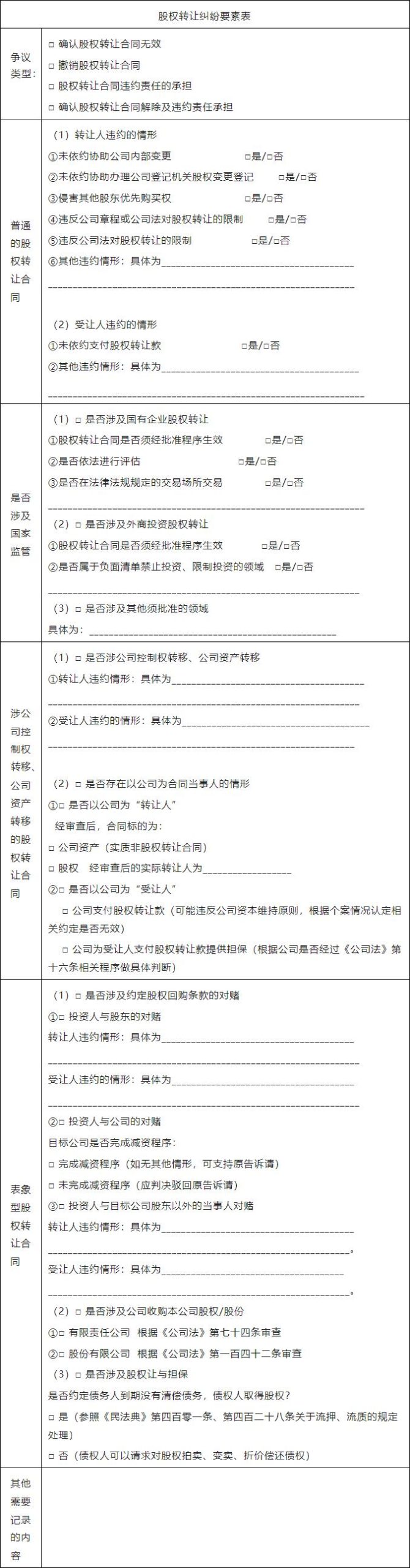
two

Essential judgment

In the case of equity transfer disputes, if the disputes between the two parties focus on one or two factors, the undisputed facts can be quickly fixed, forming the fact-finding part of the traditional judgment, and the focus of the dispute is discussed in the reasoning part. If there are many disputes between the two parties, according to the explanation of "cases that can summarize fixed elements" in "Standards for Making Civil Judgment Documents of People’s Courts" and "Styles of Civil Litigation Documents", we can no longer separate the part of stating facts and what the court thinks, identify the disputed elements one by one by means of narration and discussion, or try to adopt an element-based and modular writing mode of judgment documents, so as to draw a judgment conclusion.

Original title: Guidelines for Factor-based Trial of Equity Transfer Disputes (Trial)

Read the original text

China’s Spring Festival global "red whirlwind" shows the world’s "model"

  [Network China Festival Spring Festival]China’s Spring Festival global "red whirlwind" shows the world’s "model"

  Xinhuanet reporter Li Xiaoyu

  As an important festival handed down by the Chinese nation for thousands of years, the Spring Festival has an insurmountable position in Chinese’s mind. In recent years, the spread of the Spring Festival overseas has been accelerating and its influence has been increasing. Some countries list the Spring Festival as a legal holiday, some countries hold colorful celebrations during the Spring Festival, and many international politicians also come to join in the fun … … How did the Spring Festival blow a "red whirlwind" around the world?

  They also have a holiday during the Spring Festival — — Many countries make the Spring Festival a public holiday.

  The Spring Festival holiday is no longer just a "welfare" for the people of China. More and more countries and regions in the world have designated the Lunar New Year in China as a public holiday.

  Among Asian countries, Vietnamese, Korean, Singaporean and Malaysian countries have the same Lunar New Year holidays as China. In 2002, the Spring Festival was listed as a national public holiday in Indonesia. Since 2005, the Philippines announced that the first lunar month in China must be a national holiday.

  In addition to Asian countries, many cities and states in the United States have identified the Spring Festival in China as a statutory holiday in their own state. For example, in 2014, the Spring Festival became a statutory school holiday in New York State and the first statutory Chinese holiday in American history. There are even calls in the Chinese community to make the Lunar New Year a national legal holiday in the United States.

  At present, nearly 20 countries and regions around the world have designated the Spring Festival in China as a legal holiday for the whole or some cities under their jurisdiction. The Spring Festival in China is becoming more and more international, and it has become a festival celebrated all over the world.

  They play like this during the Spring Festival — — The world will make the Spring Festival a super big Party.

  How to spend the Spring Festival? Living in China, you can naturally talk about family reunion, visiting relatives and friends, visiting temple fairs and other activities. Unexpectedly, in foreign countries, the Spring Festival has gradually become a super event.

  In 2015, in order to celebrate the Spring Festival in China, new york held a large-scale fireworks show "Harmony with China" on the Hudson River, which was as large as the fireworks show on the National Day of the United States. This is the first time in American history that fireworks were set off on a large scale for the Spring Festival in China.

  In the Spring Festival of China in 2017, the largest celebration outside Asia was held in London, the capital of England. The parade of dragon and lion dances and floats went from Trafalgar Square to Chinatown, attracting thousands of onlookers and cheers. By the Spring Festival of 2017, the Empire State Building has been lighting up for the Spring Festival in China for 17 consecutive years, and the Sydney Opera House has also held the China New Year Bright Red Event … … The Spring Festival in China has become a grand ceremony in the world.

  With the popularity of outbound travel during the Spring Festival, many countries have tried their best to attract tourists from China, and the Spring Festival elements are everywhere, making China tourists feel at home.

  In the Spring Festival of the Year of the Rooster, China’s songs were played in shopping malls in Phuket, Thailand, Picasso’s works were exhibited at Charles de Gaulle Airport, and the China Spring Festival was called a British festival in British travel brochures. During the Spring Festival of the Year of the Monkey, Dubai Airport Duty Free Shop held a series of promotions, decorated the booth with traditional festive elements of China, and hundreds of red lanterns decorated the glittering dome of the South Bank Shopping Plaza in Los Angeles … … Tourists from China bring warmth to the world economy with weak recovery and lack of confidence, and the world has also turned the Spring Festival in China into a large carnival.

  They come to pay New Year greetings during the Spring Festival — — Foreign dignitaries came together to celebrate the New Year.

  Nowadays, more and more foreign politicians also make public appearances during the Spring Festival to pay New Year greetings to the people of China. During the Lunar New Year in China in 2017, many international dignitaries, including UN Secretary-General Gutierrez, British Prime Minister Theresa May, South African President Jacob Zuma, Canadian Prime Minister Trudeau, Cambodian Prime Minister Hun Sen and Philippine President Duterte, delivered videos or congratulatory messages to wish the people of China a happy New Year.

  There are also some politicians who "join in the fun" and personally integrate themselves into the festive atmosphere of the Spring Festival in China. In 2015, Prince Charles of England and his wife, Mrs. Duke of Cornwall, went to China City in London to watch the lion dance, learn Chinese characters, and participate in Chinese New Year celebrations. In 2017, Ivanka, the daughter of President Trump of the United States, took her daughter arabella to the China Embassy in the United States to pay a New Year’s call, which became a much-told story.

  The Spring Festival of the Year of the Dog is coming soon. How will the world celebrate the Year of China? We will wait and see!

  (Text comes from Xinhua News Agency, People’s Daily Overseas Edition, China News Network, Beijing Youth Daily, etc.)

Breaking employment discrimination, about "35-year-old threshold"

The 2022 "Government Work Report" clearly pointed out that "resolutely prevent and correct employment discrimination such as gender and age, and strive to solve outstanding problems that infringe upon the legitimate rights and interests of workers." During the two sessions of the National People’s Congress, the "35-year-old threshold" became a hot topic of discussion among deputies.

Jiang Shengnan, a representative of the National People’s Congress, was quoted as saying: at the age of 35, he is in the prime of his career, and he is also in a difficult stage of his life, with the old and the young. It is neither scientific nor fair to exclude them with only one age limit, and it is a great waste of talents.

Whether you are a young person who has just entered the workplace or a senior migrant worker who has begun to be anxious about age, there are these data that you have to know about the middle-aged crisis of the "35-year-old threshold"-

01. How to deal with the middle-aged crisis in the involution era?

Involution and anxiety have always been symbiotic. Although the average life expectancy is getting longer and longer, Chinese’s anxiety about the middle-aged crisis is getting earlier and earlier. In a survey conducted by China Youth Daily, 71.4% of the respondents claimed that they were anxious about their working age. How to deal with it? 56.9% people said that they should use their expertise to seek a breakthrough, 56.4% people thought that their core competitiveness should be enhanced, and fewer people thought that they should change careers in time to find another way out after losing their age advantage.

02. In some factories, it is too late to be anxious until you are 35.

"35-year-old age anxiety" and "middle-aged crisis in big factories" have come into reality more and more by joking. 35-year-old has indeed become an age watershed in the workplace, especially in Internet companies. Even in some big factories, it is far from enough to start anxiety at 35. According to pulse statistics, as of November 2021, the median age of Didi employees is 33 years old, while Alibaba, Ant Financial and JD.COM are 32 years old, and Baidu and Ape Tutor are even more exaggerated to be 28 years old.

03. Are you anxious about your age under the "social clock"?

Older people often tell young people what to do at what age. Work, marriage, having babies … The world of adults seems to be locked in the established "social clock". Twenty or thirty years old should be the best time in my life, but the questions from netizens in Zhihu are full of anxiety. Is it too late to be married at 26? Can I still take the civil service exam at the age of 29? These problems reveal people’s growing age anxiety.

04. Should everyone follow the social clock?

It’s time to get married, to have children, and to do things at any age. The huge social habit force requires young people to follow the "social clock" to advance their lives. Once you don’t follow the clock, the anxiety of "step by step can’t keep up" will sweep through, and families, parents and themselves will not escape.

05. I feel anxious. I am the most active after learning a new career.

People who are engaged in the preparation of milk tea drinks are called bartenders; Courier and takeaway are collectively referred to as online delivery staff; Taobao anchor is a live salesman, and these "new occupations" are becoming a new choice for the public to choose a job. The nail platform conducted a sample survey on new vocational learning groups, and found that among these people, the post-80s and post-90s are the main force, accounting for 42% and 41% respectively, and their academic qualifications are mainly junior college and undergraduate. Among the respondents, the proportion of post-80s generation who encounter occupational crisis and bottleneck is also the highest.

Summary of new cars listed in joint venture at Shanghai Auto Show by SUV

    [XCAR 2015 Shanghai Auto Show Original]

    The curtain of Shanghai Auto Show has been opened. As the largest auto show in the universe, it is a stage for car companies, a feast for the media and a paradise for car fans. For consumers who need to buy a car, the Shanghai Auto Show must not be missed. Many car companies will choose to sell new cars at the Shanghai Auto Show. Yesterday, we introduced the China brand models that were unveiled at the auto show. Today, we will continue to talk about the joint venture new cars listed at the Shanghai Auto Show, but compared with the former, the number of joint venture new cars is much less, but there are also some heavyweight models. Friends who need to buy a car must not miss it!

Summary of new cars listed by joint venture at Shanghai Auto Show

    ● Beijing benz GLA

    Price range: 269,800-398,000 yuan

    At the 2015 Shanghai Auto Show, the domestic Mercedes-Benz GLA was officially launched, and five new models were launched with a price of 269,800.


Domestic Mercedes-Benz GLA will officially go offline and will be unveiled at the Shanghai Auto Show.

Domestic Mercedes-Benz GLA will officially go offline and will be unveiled at the Shanghai Auto Show.

    The dimensions, length, width and height of the new car body are 4431mm/1804mm/1532mm respectively, and the wheelbase is 2699 mm. The domestic model maintains the same wheelbase as the overseas version, but the body height has increased (the body height of the overseas version of GLA 200 is 1483mm).

Domestic Mercedes-Benz GLA will officially go offline and will be unveiled at the Shanghai Auto Show.

Domestic Mercedes-Benz GLA will officially go offline and will be unveiled at the Shanghai Auto Show.

    In terms of interiors, the domestic GLA SUV is also highly consistent with imported models, and the independent center console and diversified color matching are very fashionable. The domestic GLA SUV will be equipped with fixed-speed cruise, reversing image, panoramic sunroof, leather steering wheel, electric seat memory and many other technical configurations.

Domestic Mercedes-Benz GLA will officially go offline and will be unveiled at the Shanghai Auto Show.

Domestic Mercedes-Benz GLA will officially go offline and will be unveiled at the Shanghai Auto Show.

    Domestic Mercedes-Benz GLA will be available in GLA 200, GLA 220 and GLA 260, of which GLA 200 is equipped with a 1.6T high-power engine with a maximum power of 115kW(156Ps). The GLA 260 will be equipped with a 2.0T high-power engine with a maximum power of 155kW(211Ps), and the GLA 220 will be equipped with a 2.0T low-power engine. In terms of transmission, all models are matched with a 7-speed dual-clutch gearbox.

    ● Dongfeng Honda new CR-V

    Price range: 179,800-249,800 yuan

    On April 20th, at the Shanghai Auto Show, Dongfeng Honda’s new CR-V was officially launched, and the new car launched seven models with the price range of 179.8-249.8 million yuan. In addition to some minor changes in design and configuration, the biggest attraction is to replace the current 5AT gearbox with CVT gearbox and adopt the Earth Dream technology engine. In addition, the official said that the old CR-V minimum will be sold together with the new model.


The official listing price of the new CR-V Shanghai Auto Show will be announced.

    In terms of appearance, Dongfeng Honda’s new CR-V has been changed in details compared with the current model, and its design style is closer to the overseas version. The new car adopts a brand-new U-shaped air intake grille, adds LED daytime running lights, and brand-new horizontal fog lights also replace the current round fog lights. In addition, a silver protective plate is added under the front bumper, which makes the whole look more fashionable.

Dongfeng Honda 2015 Honda CR-V

    In terms of size, it is reported that the length, width and height of Dongfeng Honda’s new CR-V are 4585mm/1820mm/1685mm respectively, and the wheelbase is 2620mm. In addition, the new CR-V will provide six body colors to choose from, namely colorful crystal black, scarlet, snowflake silver, titanium gold and silver, pearl white and amber brown.

Dongfeng Honda 2015 Honda CR-V

Dongfeng Honda 2015 Honda CR-V

    In terms of interior, the new CR-V has not changed much, but the interior material has been upgraded. In terms of configuration, the new CR-V top model is equipped with electric trunk door, blind spot monitoring system and 18-inch new style wheels. In addition, the new car also comes standard with tire pressure alarm, ramp assist system, body stability system, start/stop system and LED daytime running lights.

Dongfeng Honda 2015 Honda CR-V

    In terms of power, Dongfeng Honda’s new CR-V will continue the existing 2.0L engine and be equipped with a 2.4L Earth Dream engine with a maximum power of 137kW and a peak torque of 245Nm. The transmission system is matched with CVT gearbox.

Prospect of Toyota’s new cars in 2019, such as Asian Dragon/New Lei Ling.

  [car home News] In 2018, Toyota’s cumulative sales in China market reached 1.47 million vehicles (including Lexus), up 14.3% year-on-year. The two joint ventures FAW Toyota and GAC Toyota contributed 720,000 vehicles and 580,000 vehicles respectively. In fact, 2018 is not a big year for Toyota products, and it is not easy to achieve steady growth. In 2019, Toyota will step up its product offensive in China market, and launch eight brand-new models, including (|), brand-new Corolla/Lei Ling and brand-new RAV4. Not only will the sports car 86 return to the market, but Supra, which has just made its world debut, is also expected to be introduced. Then, please follow us to see what heavy products Toyota will launch in 2019.

Home of the car

 Prospect of Toyota’s new cars in 2019 brand car make and model grade Time to market page number Toyota Asian dragon in-between car Mar. first page Toyota Brand-new corolla small family car August-September first page Toyota Corolla Shuangqing E+ small family car Mar. first page Toyota New Lei Ling small family car May 20th is expected. first page Toyota Lei ling Shuang Qing E+ small family car Mar. first page Toyota Brand new RAV4 Compact SUV Between October and December Second pages Toyota 86 racing car within the year Second pages Toyota Supra racing car within the year Second pages Toyota Vellfire HEV MPV June-July Second pages

  From the perspective of specific models, Toyota’s focus in 2019 will be compact, including cars and SUVs, with a total of five models. New energy is still its focus. The fuel consumption of Corolla dual-engine E+ and Ralink dual-engine E+ PHEV models is particularly eye-catching, and the fuel consumption is 4.3L/100km under the feeding condition (that is, when the battery power is zero). In addition, Toyota also shows a more sporty side. Two sports cars, 86 and Supra, will be introduced to China. Whether the civilian sports car and Niu Mowang can continue their names is worth looking forward to.

Quickly understand the key points of this article:

1. Toyota will launch at least 9 models for the China market in 2019;

2. It includes 8 brand-new models;

3. New energy is still the key direction;

4. Try a new sports car again;

5. Toyota is stepping up its product offensive in China market.

Home of the car

● Asian dragon
Time to market: March 2019
New car features: the upgrade of appearance "arrogance" and the hybrid version are advantages.

FAW Toyota Asia Dragon 2019 Double Engine 2.5L High Edition

  The domestic Asian Dragon was launched during the 2018 Guangzhou Auto Show, and the degree of "arrogance" is further compared with the previous generation, which is even worse than Camry. Recently, Asia Dragon announced the pre-sale price of four models, of which the pre-sale price of 2.5L is 244,800 yuan; The pre-sale price of the mixed version is 239,800 yuan; The pre-sale price of the mixed version is 257,800 yuan; The pre-sale price of the hybrid version is 289,800 yuan.

FAW Toyota Asia Dragon 2019 Double Engine 2.5L High Edition

FAW Toyota Asia Dragon 2019 Double Engine 2.5L High Edition

"Domestic Asian Dragon Double Engine"

Toyota (Import) Asian Dragon (Overseas) 2018 Basic Model

"Overseas version"

  The domestic version of the Asian Dragon retains the overall design of the overseas version. The exaggerated front grille almost occupies the front of the car, with angular LED light sets and front bumper lines, showing a strong momentum. However, the new car is not equipped with the LED headlight group with Pisces bone-shaped daytime running lights of overseas high-profile models, but is replaced with a unique three-circle full LED headlight. From the visual perception, the sharpness of the latter’s "eyes" is obviously lower than that of the overseas version of "fishbone lights".

FAW Toyota Asia Dragon 2019 Double Engine 2.5L High Edition

FAW Toyota Asia Dragon 2019 Double Engine 2.5L High Edition

  Viewed from the side, the Asian Dragon looks very elegant, and the low body style makes the new car look more stretched. On the tail side, the car uses a through taillight group with a full-fledged rear bumper, which greatly improves the sports temperament of the new car. In terms of body size, the length, width and height of the new car are 4975/1850/1450mm and the wheelbase is 2870mm respectively.

FAW Toyota Asia Dragon 2019 Double Engine 2.5L High Edition

  In terms of interior, the new car adopts a symmetrical design style, which is not the same as Camry, and it shows a calm atmosphere. The most attractive thing in the whole central control area is this 9-inch central control LCD screen, which integrates conventional multimedia functions, is easy to operate and supports Apple CarPlay function.

FAW Toyota Asia Dragon 2019 Double Engine 2.5L High Edition

  In terms of configuration, the new car will be equipped with leather seats, panoramic sunroof and sewing design of door trim panels. Another highlight of the new generation of Asian Dragon is that AVS adaptive variable suspension system will be standard, which can effectively improve ride comfort and driving stability.

FAW Toyota Asia Dragon 2019 Double Engine 2.5L High Edition

  Domestic Asian Dragon provides 2.5L inline four-cylinder naturally aspirated engine and 2.5L hybrid engine, both of which are A25A 2.5L naturally aspirated engines of Toyota Dynamic Force series, with maximum thermal efficiency of 40% and 41% respectively. Among them, the maximum power of the 2.5L model is 209 horsepower, and the transmission system is matched with the 8-speed automatic manual transmission; However, the maximum power of the 2.5L engine of the twin-engine model is 178 HP, the maximum power of the motor is 120 HP, and the comprehensive maximum power of the system is 218 HP. In terms of fuel consumption, it is officially announced that the comprehensive fuel consumption of the 2.5L+8AT model is 6.2L/100km, while the dual-engine model is only 4.3L/100km.

Editor’s comment:

FAW Toyota Asia Dragon 2019 2.5L Hybrid Edition

  In the medium-sized automobile market, FAW Toyota has been silent for a year after Reiz stopped production in September 2017. Fortunately, in November 2018, FAW Toyota officially released the domestic Avalon (Asian Dragon). The exaggerated design language of the new car instantly makes this medium-sized car, which was originally moderate and steady, run wild, and also brings fresh blood to the domestic joint venture brand medium-sized car market. At the same time, the addition of Asian Dragon has also broken the status quo that Toyota’s medium-sized car is only Camry "single-handedly" and seized more shares for it.

  However, from the perspective of Camry and ES of Toyota’s domestic layout, how to differentiate and price the Asian dragons on the same platform has become its first consideration. Judging from the pre-sale price recently released, the price of the hybrid version of FAW Toyota Asia Dragon is basically the same as that of the fuel version, which obviously comes with sincerity, and the main sales model is between Camry and ES, and Toyota really plays a "good card". As for whether it can impress consumers after listing, it remains to be tested by the market.

Home of the car

● New Corolla/Lei Ling (including double engines)
Time to market: August-September, 2019 (Corolla) and May 20, 2019 (Lei Ling).
New car features: drastic changes

FAW Toyota Corolla 2019 Dual Engine 1.8L Basic Model

GAC Toyota Lei Ling 2019 Double Engine Basic Model

"The picture shows the new Corolla Twin Engine/Ralink Twin Engine"

  The brand-new Corolla sedan and Lei Ling sedan made by Toyota’s two China partners ushered in the debut at the 2018 Guangzhou Auto Show eight months after the launch of the American version of Corolla (the car released at the auto show is a hybrid version). Of course, the relationship between the two is still a sister car, and the visible difference at present is only in the appearance. Compared with the sedan image of current models, the brand-new Corolla/Lei Ling based on TNGA architecture is young and avant-garde in appearance.

FAW Toyota Corolla 2019 Dual Engine 1.8L Basic Model

GAC Toyota Lei Ling 2019 Double Engine Basic Model

  The front face shapes of the new Corolla and Ralink are obviously different. The former does not use the "fangs" headlights of overseas models, while the front face of Ralink is closer to the overseas version. The large-area grille on the front of the car is eye-catching. The difference is that Corolla is a banner style, while Ralink is a mesh design.

FAW Toyota Corolla 2019 Dual Engine 1.8L Basic Model

GAC Toyota Lei Ling 2019 Double Engine Basic Model

  In the rear part, there are still obvious differences between the two cars. Corolla takes a simple route and Ralink is a sporty style. The most direct advantage of this design is that the Corolla and Lei Ling can be easily distinguished from the front face and the rear of the car.

Home of the car

  In addition, Toyota China announced at the launch that the new Corolla/Lei Ling will be equipped with the China version of the exclusive 12.1-inch central control panel and PM2.5 filtering system. Compared with the overseas version of the 8-inch screen, this can be said to be considerate of the needs of consumers in China. In terms of configuration, the new car will also be provided with the latest generation of Zhixing interconnection system and Zhixing safety system, of which the latest Zhixing interconnection system will be 100% installed in all future replacement cars of Toyota. As for the power part, the official has not announced the specific parameters of the new car power, only revealing that the new car will be equipped with the latest version of the 1.8L hybrid system.

Editor’s comment:

Home of the car

  As the sales pillars of Toyota in China market, Corolla and Lei Ling shoulder the heavy responsibility of stabilizing the compact car market, laying a solid foundation for Toyota’s expansion in China market. According to the latest data, the cumulative retail sales of Corolla in 2018 was 294,300, and the sales of twin-engine models were 82,400, up 3% and 41% respectively. The annual sales volume of Lei Ling (including double engines) reached 202,700 vehicles, a year-on-year increase of 21%.

  Obviously, the Gemini strategy has not caused each other to seize the market, but has successfully met the needs of different consumers, and each has its own advantages to meet the needs of more consumers and win market share. The existing data show that the interior changes are also huge and are loved by consumers. As for the market performance after listing, these two cars are expected to continue their cash sales or will usher in new growth.

Home of the car

● Corolla/Ralink engine E+
Time to market: March 2019 (Corolla Shuangqing E+) and March 2019 (Ralink Shuangqing E+)
New car features: fuel consumption under feed condition is 4.3L/100km.

Home of the car

  At the 2018 Beijing Auto Show, Toyota fulfilled its promise made two years ago and released the Corolla/Ralink E+ at the same time. These two models are exclusive to the China market, and they share a plug-in hybrid system consisting of a 1.8L naturally aspirated engine, two motors and a battery pack. According to official data, the fuel consumption of the whole system is 1.3L/100km under comprehensive working conditions and 4.3L/100km under feed working conditions (that is, when the battery power is zero), which can be described as strong competitiveness.

FAW Toyota Corolla Twin Engine E+ 2019 1.8L Ultimate Edition

GAC Toyota Ralink Shuangqing E+ 2018 Basic Model

"The picture shows Corolla double engine E+ and Ralink double engine E+"

  Let’s look at the appearance first. Both cars continue the design of the current fuel version, only the details are different. In the details, the new car has added blue elements to the front grille and headlights to highlight its new energy identity. In addition, the headlight light source comes standard with LED, and the LED daytime running light of Corolla dual-engine E+ is only available for two models with high allocation.

FAW Toyota Corolla Twin Engine E+ 2019 1.8L Ultimate Edition

GAC Toyota Ralink Shuangqing E+ 2019 Basic Model

  In the rear part, each of the two cars has a blue decorative strip that runs through both sides. The Corolla dual-engine E+ is more obvious, and the rest is not much different from the fuel version. The fuel filler is on the left side of the car body, and the charging port is on the right side of the car body. In the charging part, take the Corolla dual-engine E+ as an example. The car supports public AC charging piles and portable chargers, which take about 3 hours and 5 hours to be fully charged respectively.

FAW Toyota Corolla Twin Engine E+ 2019 1.8L Ultimate Edition

The picture shows the Corolla twin-engine E+, which is only different from the Ralink twin-engine E+ in configuration.

  In terms of interiors, both cars follow the fuel version of the car design, and there are no popular elements at present, which may be its charm. In terms of configuration, the new car uses an 8-inch touch screen and supports the interconnection function of Baidu CarLife mobile phone. But there is no reversing radar function in the whole system.

FAW Toyota Corolla Twin Engine E+ 2019 1.8L Ultimate Edition

  In terms of power, both cars are equipped with a plug-in hybrid system consisting of a 1.8L naturally aspirated engine, dual motors and battery packs, in which the maximum power of the engine is 99 HP and the maximum torque is 142 Nm; The maximum power of the motor is 72 HP and the maximum torque is 207 Nm. In terms of transmission system, it still matches the E-CVT continuously variable gearbox; The cruising range of the car in pure electric mode is 55km.

Editor’s comment:

FAW Toyota Corolla Twin Engine E+ 2019 1.8L Ultimate Edition

  Toyota’s plug-in hybrid version based on Corolla and Lei Ling cars is easy to understand, which is intended to inherit the golden signboard of Corolla, and the hybrid technology has been very mature for many years. In addition, the double-point system requires Toyota to have corresponding plug-in or pure electric vehicles in China, so it is a route that can be realized quickly based on cash.

  Judging from the latest sales data, the cumulative sales volume of Corolla Shuangqing from January to December was 82,400 units, a year-on-year increase of 41%; The cumulative sales volume of Leiling Shuangqing this year is 44,600 units. It is not difficult to see that consumers are gradually recognizing Toyota hybrid technology. Reliable and mature hybrid technology, low fuel consumption and high user base and reputation of Corolla/Lei Ling will lay a good starting point for these two plug-in hybrid models.

National nutrition plan opens a new era of national health

In a healthy China, nutrition comes first, and nutrition is the material basis of national quality. With the continuous improvement of people’s living standards in China, the nutrition supply capacity has been significantly enhanced, and the national nutrition and health status has been significantly improved. However, it still faces the problems of frequent nutrition-related diseases and the lack of popularization of a nutritious and healthy lifestyle, which has become an important factor affecting national health. In the past two years, many programmatic documents, including "Healthy China 2030" and "National Nutrition Plan", have made demands on improving national nutrition and quality, and believe that a new era of national health will surely come.

The problem of national undernutrition and excess coexist.

In recent years, the dietary and nutritional status of urban and rural residents in China has changed greatly. Previously, the Report on Nutrition and Chronic Diseases of China Residents released by the National Health Planning Commission analyzed and evaluated the changes of nutrition and chronic diseases of Chinese residents in the past 10 years. The report shows that after years of efforts, the nutritional status of Chinese residents has improved significantly, which is manifested in the following aspects: the physical and nutritional development of residents has improved, the height and weight of residents have increased, and the growth retardation and malnutrition have improved significantly; But at the same time, with the increase of residents’ intake of fat and high-quality protein, the problem of overweight and obesity is becoming more and more serious, which has also become the main cause of hypertension, diabetes and cardiovascular and cerebrovascular diseases in adults.

At the same time, "Healthy China 2030" also pointed out that the overall situation of national nutrition in China at present is that some residents lack micronutrients, some people consume too much high-calorie foods such as oil, and the problems of insufficient nutrition and excess nutrition coexist.

Nutrition science popularization will be more standardized and normalized.

With the continuous development of mobile internet technology, nutrition science popularization has become the norm in citizens’ daily life. When people turn on their mobile phones, they can often see the sharing and pushing of nutrition and health. While spreading nutrition knowledge to the citizens, there are also some false information that has a great misleading effect on the citizens.

In July this year, the State Council issued the National Nutrition Plan (2017-2030), which deployed seven implementation strategies to ensure the work, of which the seventh clearly stated that it is necessary to popularize nutrition and health knowledge and promote the normalization of nutrition and health science education activities.

Liu Ping, deputy director of the National Food Safety Risk Assessment Center, once said in an interview with the media that the popularization of science in nutrition and food safety has been done for many years, such as the annual National Nutrition Week, Food Safety Week, Nutrition and Health Lecture Hall, etc., which has made positive contributions to promoting the dissemination of science, nutrition and health knowledge. At the same time, however, the traditional one-way information dissemination and propaganda mode is still the main mode of nutrition science popularization in China. The information supply is insufficient, and the content and form are relatively simple, which is not enough to meet the nutritional and health needs of the public. It also provides an opportunity for some nutrition pseudo-experts, and some so-called "masters" appear to confuse the audience.

In order to solve these problems, the Plan proposes to innovate the expression forms of popular science information on nutrition, establish a free and shared national popular science platform on nutrition food safety, and adopt various communication modes and channels to provide popular science information to different groups in a targeted and accurate manner. At the same time, it will also strengthen the construction of popular science teams for nutritious food safety, discover and correct pseudo-scientific nutritional information in time, and truly convey scientific and healthy nutritional knowledge to the public.

Grain nutrition has been mentioned in a more prominent position.

Cereals are an important source of human energy, which can avoid the disadvantages of high energy and high fat, and play an important role in promoting human health. In recent years, with the change of lifestyle, the problem of uneven diet among China residents has become increasingly prominent. According to the survey on the Intake of Coarse Grains among Adult Residents in China, which was participated by China Nutrition Association, more than 80% of adult residents in China have insufficient intake of whole grains, and the proportion of grains in the nutritious foods concerned is also small.

In order to adjust residents’ diet structure and balance their diet, in the new version of Dietary Guidelines for China Residents released in 2016, "Variety of food and cereal as the main recommendation" was put forward as the first item, and people were strongly encouraged to change their diet structure and increase their cereal intake. At the same time, the National Nutrition Week held from May 14 to May 20, 2017 took "whole grain, nutrition+"as the theme, and during the nutrition week, a series of activities were launched to help residents choose nutritious and high-quality grains.

At present, all kinds of cereal products have appeared in the market and gradually become a part of citizens’ lives. In the future, grain will certainly play a more important role in the daily life of citizens.

Special medical food will become an effective supplement to national nutrition.

In national nutrition, there is a very important part-the nutrition problem of patients. However, this issue has not been paid enough attention. The National Nutrition Plan puts forward six major actions, one of which is the clinical nutrition action, aiming at strengthening the nutritional diagnosis and treatment of patients and improving their nutritional status.

Professor Shi Hanping, Chairman of the Application Committee of Formulated Foods for Special Medical Use of China Nutrition and Health Food Association, said at the first Guangdong Symposium on Formulated Foods for Special Medical Use in 2017 that nutritional therapy is another treatment method that pays equal attention to surgery, radiotherapy, chemotherapy and other treatments. It should be the basic treatment method or first-line treatment method for patients, and it is a real integrated treatment. However, among the 140 million inpatients in China, less than 1% have received clinical nutrition diagnosis and treatment, while hundreds of millions of patients with chronic non-communicable diseases outside the hospital are still in an unattended state. The incidence rate of malnutrition in major diseases such as cancer patients is 70%-80%, and the needs of tens of millions of patients are not met.

Professor Shi Hanping’s clinical nutrition therapy refers to special medical food, that is, formula food for special medical use, which is specially processed and prepared to meet the special needs of people with limited eating, digestive and absorption disorders, metabolic disorders or specific disease States for nutrients or meals. Generally speaking, special medical food is food for patients, which has a direct promoting effect on patients’ recovery.

China’s special medical food started late, but the state attaches great importance to its development. In recent two years, the relevant policies and systems of special medical food have been intensively introduced, and the industry norms have been continuously improved. In March 2016, the State Food and Drug Administration issued the Measures for the Administration of the Registration of Formulated Foods for Special Medical Uses; In November 2016, the State Food and Drug Administration issued the "Quality Management Standards for Clinical Trials of Formulated Foods for Special Medical Use (Trial)". In September 2017, the State Food and Drug Administration issued an announcement on the items and requirements of application materials for the registration of formula food for special medical use (Trial) and the research requirements for the stability of formula food for special medical use (Trial).

The introduction of this series of measures not only has positive promotion significance for the development of special medical food industry, but also effectively supplements the shortcomings of national nutrition in the past. More importantly, it has played the most direct and effective help for the majority of patients. (Reporter Zhu Fenglan/Wen)


Action of poverty alleviation doctors: from common diseases to rare diseases, "no one can be less"

  editorial comment/noteHe walked into wumeng mountain from Beijing Grand Hospital, the capital. Together with his colleagues and local doctors, he did his part to improve the local medical service ability and relieve patients’ pain, so that a single spark could start a prairie fire. Strive for a new era, and take responsibility for poverty alleviation. CCTV focused on the front line of health poverty alleviation, followed Yin Jian, a neurologist at Beijing Hospital, to Dafang County, Bijie City, Guizhou Province, and told the story of "poverty alleviation" in the depths of the mountains.

  Dr. Yin Jian (second from the left in the back row) is making rounds in the ward.

  Cctv newsDafang County, Guizhou Province is located in wumeng mountain, southwest China, at an altitude of 1,600 meters. Here, mountains are connected with mountains and water is connected with water, which is magnificent and is the hinterland of Yunnan-Guizhou Plateau. It’s cold in winter, and you can’t see the sun for more than 20 days. It’s rainy and wet, and the ground is muddy. This is somewhat unsuitable for a northerner born and raised like Yin Jian. At the end of 2018, as the backbone of the neurology department of Beijing Hospital, Dr. Yin Jian was sent to Dafang County People’s Hospital of Guizhou Province as the temporary vice president for half a year by the the State Council Poverty Alleviation Office to carry out professional and technical precision poverty alleviation work. He admitted that his initial concept of Dafang County and even Guizhou was very vague. When he set foot on that land, he was deeply attracted by the beautiful local scenery. Xi Huan, Dean of National Geriatrics Center; Chen Tong and Pan Qi, deputy directors of the Medical Department of Beijing Hospital, attached great importance to the national poverty alleviation program. Before leaving, they specially instructed Beijing Hospital to be the national geriatric center and the core hospital of the national difficult disease diagnosis and treatment capacity improvement project, and fully supported the generous poverty alleviation project.

  Although Dafang County is a national poverty-stricken county, it has a rich history and culture. It is located at the junction of Han nationality, Miao nationality and Yi nationality, with 33.2% ethnic minorities. The population is scattered and the degree of urbanization is low. However, due to its high fertility rate, the population reaches one million, and most of them are young people, this small town is full of vitality.

  Dafang County is located in a remote area with poor infrastructure and conditions, and the expressway to Guiyang, the provincial capital, was completed in 2016. Only two slow trains reach the provincial capital every day. The local people have limited health knowledge and insufficient health awareness. It is very common that minor illness depends on forbearance, serious illness depends on fate, and chronic illness depends on remedies and inertia, relying on the help of the government and superiors. These problems are really in front of Yin Jian, and they have also become the driving force behind his work.

  Advancing by groping, promoting the construction of stroke center in local hospital

  Yin Jian learned from Dafang County Health and Health Commission that the county is a high-fluorine area and a high-prevalence area of tuberculosis. The diet is high in salt, alcoholism and smoking are common. The typical disease spectrum of developing countries in transition is high in metabolic syndrome, hypertension, coronary heart disease and stroke, and the incidence of malignant tumors is rising. At the same time, the high incidence of infectious diseases represented by tuberculosis in this area is still a social problem that needs great attention.

  However, the training of local health personnel is seriously inadequate. In 2018, there were only 51 lectures and trainings by experts outside the county; 174 person-times of advanced medical care. After many visits and repeated communication with local medical staff, Yin Jian found that stroke is a frequently-occurring disease in the local area. If Dafang County Hospital joins the construction of "Brain Prevention Committee-Stroke Center" promoted by Guizhou Provincial Health and Wellness Committee, it will greatly promote the prevention and control of stroke. Yin Jian immediately communicated this idea with Wu Guangming, Dean of Dafang County People’s Hospital, and Comrade Li Jian, head of Dafang County Health and Wellness Committee, and everyone hit it off. And actively contact with director Liu Zhen, who was sent by Beijing Hospital to the People’s Hospital of Guizhou Province, vice president Chu Lan of the Affiliated Hospital of Guizhou Medical University, director Xu Ping and director Xu Zucai of the Affiliated Hospital of Zunyi Medical University, and director Luo Yong of the Department of Neurology of Zunyi First People’s Hospital; Professor Kuang Shixiang from the Second Affiliated Hospital of Guizhou University of Traditional Chinese Medicine sought professional and organizational training in Stroke Center.

  In order to ensure the solid landing of the stroke center, with the approval of the hospital, Yin Jian overcame difficulties and extended counterpart assistance for three months. Hard work pays off. In May, 2019, Dafang County People’s Stroke Center was approved by the National Health and Wellness Commission and became the first batch of county-level "Demonstration Stroke Prevention Centers" in Guizhou. It was officially awarded in the National Convention Center, and the county government departments coordinated the municipal departments to make city guide signs.

  Yin Jian talked about the completion of the stroke center, which was both exciting and gratifying. He said: "This is the result of the precise help of the leaders of Beijing Hospital and the strong support of many related personnel." He hopes that the stroke center can benefit the people on this side, and it can be regarded as doing his bit.

  Realizing the Breakthrough from 0 to 1 for Difficult and Rare Diseases with Professional Skills

  As a neurologist engaged in the research and clinical treatment of difficult and rare diseases, Dr. Yin Jian wanted to use his medical knowledge to do something practical for the local people. Before leaving, he specially consulted many senior experts in the hospital, and everyone said that he would open all the resources of Beijing Hospital to complete the task of counterpart assistance. On the occasion of leaving Beijing, Yin Jian decided to take this as another important starting point for this professional poverty alleviation.

  After several rounds of rounds in the hospital, Yin Jian found that the patients in Dafang County’s local neurology department were mainly cerebrovascular diseases, but there were many problems of unclear diagnosis of difficult and rare diseases. Difficult and rare diseases in the nervous system were one of Yin Jian’s main areas of attack. He wanted to give play to his expertise in this respect, so he pioneered the joint provincial hospitals (Affiliated Hospital of Guizhou Medical University, People’s Hospital of Guizhou Province, Affiliated Hospital of Zunyi Medical University initiated and founded the "Consultation Center for Difficult Diseases in the Department of Neurology of Guizhou Province", which created a fixed learning and communication platform for neurologists in Dafang County Hospital. Doctors from Dafang County People’s Hospital participated and studied for free as grassroots units. This is the first batch of only county-level hospitals in Guizhou Province to participate in the consultation center.

  There are many poor patients in Guizhou. Yin Jian also took advantage of the domestic first-class experimental diagnosis platform for neuroimmune diseases built by Professor Xu Xianhao and Professor Zhang Hua in the Department of Neurology of Beijing Hospital, and took the initiative to take out his own research funds to test biological samples for local patients in Guizhou free of charge. He said: "During my six months of poverty alleviation in Guizhou, wang hong, a technician in the laboratory, has tested hundreds of serum and cerebrospinal fluid of patients in Guizhou, and at least dozens of myasthenia gravis patients have been screened and diagnosed (three of them are even rarer, accounting for only about 4% of all myasthenia gravis patients with Musk antibody positive, all of which are long-term undiagnosed patients with the longest course of 12 years) and four cases are NMOSD (neuromyelitis pedigree disease).

  On the platform of consultation center, under the remote guidance of six doctors, including Director Chen Haibo, Deputy Director Gong Tao and Director Li Shuhua, from the Department of Neurology of Beijing Hospital, one case of very rare intranuclear inclusion body disease (NIID) and one case of CLIPPERS (chronic lymphocytic inflammation with pons-cerebellar peripheral enhancement syndrome) were diagnosed, which were unanimously praised by local patients and colleagues.

  Four unusual cases

  Speaking of difficult and rare cases of nervous system, Yin Jian mentioned an 84-year-old man who was diagnosed with neuromyelitis optica spectrum disease. At first, the old man went to the ophthalmology department because he couldn’t see one eye. The doctor suspected that it was neuromyelitis optica spectrum disease. Later, the ophthalmologist recommended him to go to the neurology department for further examination. However, due to the extremely low incidence of this disease, only about 10/100,000, the local hospital dared not make a diagnosis. The deputy director of the congratulatory message of Guizhou Medical University mentioned this case in the consultation center for difficult diseases. After discussion and exchange, it was decided to send the sample to Beijing Hospital for testing. Finally, the specific AQP4 antibody was captured by CBA immunofluorescence technique in Beijing Hospital, and it was diagnosed as NMOSD (neuromyelitis pedigree disease). Due to the timely diagnosis, the old man’s eyes have now recovered. This is the elderly patient with the highest onset reported in domestic literature.

  There is also a local grandmother in Dafang County, who is nearly seventy years old. Her tongue has shrunk and she has been transferred to many hospitals in the province. She has been diagnosed with amyotrophic lateral sclerosis (ASL), and her family and I have basically given up treatment, so she can’t eat and swallow, comb her hair and brush her teeth. However, after carefully observing her EMG, Yin Jian found that it did not meet the EMG characteristics of patients with gradual freezing. Her serum was sent to the neuroimmunology laboratory of Beijing Hospital, and the antibody against multiple gangliosides was found to be positive by using the latest BOLT immunoassay in China. Later, it was diagnosed as a rare Lewis summer syndrome. Follow-up treatment is not very smooth. Yin Jian said that because the local people’s health awareness is not strong, once they encounter rare and difficult diseases, especially when they are old, they often choose to give up treatment. The old lady did not cooperate with lumbar puncture at first, and with the persuasion and efforts of doctors, the old lady accepted the examination and completed the diagnosis. After immunotherapy, I have recovered very well now, and I can wash my face, brush my teeth and eat independently.

  During Yin Jian’s stay in Guizhou, a patient with severe subarachnoid hemorrhage was transferred to the Affiliated Hospital of Guizhou Medical University. However, the location of the aneurysm is special, and the blood supply of the parent artery is complicated, so the symptoms of the patients who failed the first operation in the local hospital continue to deteriorate. Yin Jian urgently asked Wang Lijun, chief physician of neurosurgery department of Peking Hospital, the National Geriatrics Center, to consult, and flew to Guizhou at the request of the local hospital. In Guizhou, the world’s thinnest floating guide wire was used for the first time to successfully embolize this complicated posterior circulation aneurysm, which successfully saved the patient’s life. It shows the strength of endovascular treatment of neurosurgery in Beijing Hospital.

  There are many local families who are poor because of illness. During the period of helping in Guizhou, a local helping cadre found Yin Jian, saying that the child of the family he helped was only four years old this year, with drooping eyelids and fixed eyeballs. Previously, the provincial hospital diagnosed myasthenia gravis and said that the symptoms were more serious. Because the family was poor and could not afford the follow-up treatment, the boy’s father decided to give up and let it develop, but the child’s mother insisted on treatment. The local conditions are limited, so it is impossible to do electromyography examination. Yin Jian wants to give the child a set of standard formal tests first, and bring the child’s serum samples back to Beijing Hospital during the Spring Festival, so that Mr. wang hong can use the latest international double antigen immune competition inhibition enzyme-labeled immunoassay for further detection of acetylcholine receptor antibodies and Musk antibodies, and finally it is diagnosed as ocular myasthenia gravis. However, during the test, it was found that the antibody titer in the little boy’s body was not too high, and it was not too serious to be cured. Generally, it would not affect the child’s learning and life expectancy. The child’s mother was very happy after hearing the news. As a parent, Yin Jian understands this kind of mood very well, and has also formed "WeChat friends" with the mother and son, so that they can come to Beijing for follow-up regularly and make a systematic examination and long-term follow-up plan for their children.

  Yin Jian recalled the days when he helped in Dafang County and said, "I didn’t do anything special, but in my opinion, I did something with goals: one was to promote the construction of Dafang County Stroke Center; The other is the breakthrough in the realization of local difficult and rare diseases from thinking about trying to diagnosis. I have also become friends with some patients and local doctors and formed a pair. They will come to me if they need help, and I will do my best. "

  Although I haven’t been in Dafang County, Guizhou Province for a long time, I read deep feelings from Yin Jian’s words in the interview. "Our generosity is really beautiful, and we are located in a foggy area. Driving on the road has a feeling of" walking on clouds ".It is like a fairyland. If there is an opportunity, we must go and have a look! Here you can see the magnificence of China’s mountains and rivers and the determination and efforts of the party and the country to declare war on poverty. You will feel the greatness of China and the hope of China! "

Play with your mobile phone, Happy Sugar Bean Man! Pocket Internet Cafe: Men and women rush forward!

The cute "Sugar Bean Man: The Ultimate Elimination" seized the hot tail of summer, and this game, which won the steam weekly sales list for three times, ranked third in the number of people online after "DOTA2". Easy, interesting, fast-paced variety play, chicken eating mode and lovely painting style can be said to be the "secret of success" of this work.

At present, PS4 and steam are the first platforms on which Sugar Bean Man logs in. Many players think this game is very suitable for mobile platforms, such as Nintendo’s NS handheld and mobile phone tablet.

However, it has been confirmed that NS version and mobile version will be launched in the future. Players still need to wait for a while. Of course, players who don’t want to play this game in front of the computer can also play on their mobile phones through the cloud game platform of the handheld Internet cafe ~

Pocket Internet Cafe is a cloud game platform based on X86 architecture. It connects high-performance computers in the cloud through the network, so that players can play any PC game on their mobile phones in the form of streaming, making the players’ mobile phones change into handhelds every second. Therefore, it is no longer necessary to play "Sugar Bean Man" on the mobile phone.

For players who haven’t bought Sugar Bean Man, the Pocket Internet Cafe provides a game account for free. Players can play this game in seconds when they enter the APP, buy it early and enjoy it early, and don’t buy it 100%! Play ~

Play with your mobile phone, Happy Sugar Bean Man! Pocket Internet Cafe: Men and women rush forward!

The variety play of "Sugar Bean Man" can be said to be the essence of the game. I believe that many players have watched live-action programs on TV. Sometimes players often make mistakes in seemingly simple levels, and many players who look across the screen think it is easy for me to get on. Is that really the case?

In fact, seemingly simple hurdles test each player’s physical strength and quick response ability.

Play with your mobile phone, Happy Sugar Bean Man! Pocket Internet Cafe: Men and women rush forward!

The game "Sugar Bean Man" just provides a "personal challenge" opportunity for players who are eager to try through the screen. In fact, this game seems simple without complicated operation, but each player has to face 59 other players, and it is not easy to eat chicken in the end ~

Sometimes many players will be eliminated at the first level, but it is such a relaxed and interesting gameplay that players can always enjoy this and lose again and again.

Play with your mobile phone, Happy Sugar Bean Man! Pocket Internet Cafe: Men and women rush forward!

Players can play this interesting game anytime and anywhere through the handheld Internet cafe cloud game platform, just like playing a mobile game. In terms of operation, although the Pocket Internet Cafe supports external keyboard and mouse, since it is necessary to have the experience of mobile game version, the virtual keyboard function of the Pocket Internet Cafe is more convenient, and it also has the taste of mobile game ~

Play with your mobile phone, Happy Sugar Bean Man! Pocket Internet Cafe: Men and women rush forward!

In terms of practical operation, when entering the game, the handheld internet cafe has already preset the key positions to be used in the game. Of course, players can also customize the layout according to their mobile phone screen size and operating habits. This will also help you to go through five levels between square inches, cut six generals, and control your "love beans" to eat chicken smoothly!

Play with your mobile phone, Happy Sugar Bean Man! Pocket Internet Cafe: Men and women rush forward!

In terms of game experience, although it is a form of cloud game, the game runs in the cloud, and the game screen is compressed and manipulated to stream to the user’s mobile phone in the form of video stream, but the actual game screen and color reproduction will not be lost. At the same time, the handheld Internet cafe can automatically adjust the image quality according to the player’s network environment, and the delay will be well controlled, and the operation is very smooth, just like playing on a local device.

Finally, you like the game "Sugar Bean Man" and don’t want to be confined to sitting in front of the computer to play. Perhaps the handheld Internet cafe is a good choice, and the sense of sight like a mobile game will make you rush on your mobile phone ~

Notice of the General Office of the State Council on printing and distributing the pilot program of centralized drug procurement and use organized by the state

General Office of the State Council on Printing and Distributing Drugs Organized by the State

Notice of centralized procurement and use of pilot programs

Guo Ban Fa [2019] No.2

People’s governments of all provinces, autonomous regions and municipalities directly under the Central Government, ministries and commissions and institutions directly under the State Council:

"The pilot program of centralized drug procurement and use organized by the state" (hereinafter referred to as the "program") has been approved by the State Council and is hereby issued to you, please implement it carefully.

All pilot cities should formulate implementation plans and supporting policies in accordance with the requirements of the "Program", strengthen organizational leadership, compact responsibilities at all levels, do a good job in publicity and guidance, and prevent risks to ensure the implementation of pilot tasks. Relevant provinces should closely follow the implementation of the pilot, actively create conditions, give support to pilot cities, and strengthen guidance, supervision and assessment.

All relevant departments and units should, in accordance with the requirements of division of labor, further decompose and refine the work involving their own departments and units, pay close attention to formulating specific measures, clarify the schedule, and promote implementation item by item. Involving multiple departments, the lead department should strengthen coordination and the relevant departments should cooperate closely. It is necessary to strengthen the overall concept, strengthen communication and cooperation, and achieve layout, supervision and results. The office of the pilot working group for centralized drug procurement and use organized by the state shall, jointly with relevant departments, do a good job in monitoring and analysis, regular notification, supervision and inspection, summary and evaluation, etc., and carry out key supervision in the pilot areas with slow progress and no obvious results, and report major issues to the State Council in a timely manner.

the General Office of the State Council          

January 1, 2019          

(This piece is publicly released)

The state organizes a pilot program for centralized drug procurement and use.

According to the deployment of the CPC Central Committee and the State Council, this plan is formulated in order to deepen the reform of the medical and health system, improve the drug price formation mechanism, and carry out the pilot project of centralized drug procurement and use organized by the state.

I. General requirements

(1) objectives and tasks.Eleven cities, including Beijing, Tianjin, Shanghai, Chongqing, Shenyang, Dalian, Xiamen, Guangzhou, Shenzhen, Chengdu and Xi ‘an, were selected to select pilot varieties from generic drugs that passed the consistency evaluation of quality and efficacy (including the consistency evaluation according to the new registration classification of chemical drugs, hereinafter referred to as consistency evaluation), and the state organized the centralized procurement and use of drugs to realize the obvious reduction of drug prices and reduce the burden of patients’ drug expenses; Reduce the transaction cost of enterprises, purify the circulation environment and improve the industry ecology; Guide medical institutions to standardize drug use and support the reform of public hospitals; Explore and improve the centralized drug procurement mechanism and the market-oriented drug price formation mechanism.

(2) General idea.According to the general idea of national organization, alliance procurement and platform operation, that is, the state formulates basic policies, scope and requirements, organizes pilot areas to form alliances, and explores cross-regional alliance centralized procurement with quantity by taking public medical institutions in alliance areas as the main body of centralized procurement. On the basis of summarizing and evaluating the pilot work, we will gradually expand the coverage of centralized procurement and guide the society to form long-term stable expectations.

(3) Basic principles.First, adhere to the people-centered, ensure the demand for clinical drugs, effectively reduce the burden on patients, and ensure the quality and supply of drugs. Second, adhere to compliance with laws and regulations, strictly implement relevant policies and regulations, and ensure that special procurement procedures are standardized, open and transparent, and accept supervision from all parties throughout the process. Third, adhere to the combination of market mechanism and government role, not only respect the market-oriented drug price formation mechanism, but also give full play to the role of the government in building a platform, promoting docking, ensuring supply and strengthening supervision. Fourth, adhere to a smooth transition and proper convergence, and handle the relationship between the pilot work and the existing procurement policy.

Second, the scope and form of centralized procurement

(a) to participate in the enterprise.Any pharmaceutical manufacturer approved by the State Drug Administration and listed in Chinese mainland area within the scope of centralized procurement (the national general agent of imported drugs is regarded as a manufacturer) may participate.

(2) scope of drugs.Select pilot varieties from generic drugs corresponding to generic drugs that have passed the consistency evaluation.

(3) shortlisting criteria.Including quality shortlisting criteria and supply shortlisting criteria. The quality shortlisting criteria mainly consider the clinical efficacy, adverse reactions, batch stability, etc., and are based on the consistency evaluation in principle. The supply shortlisting criteria mainly consider the production capacity and supply stability of enterprises, and enterprises that can ensure the procurement volume in the pilot areas can be shortlisted. The specific indicators of shortlisting criteria shall be drawn up by the Joint Procurement Office.

(4) The form of centralized procurement.According to the number of short-listed production enterprises of each drug, the corresponding centralized procurement method is adopted: if there are three or more short-listed production enterprises, the bidding procurement method is adopted; If there are two short-listed production enterprises, they shall adopt the way of bargaining purchase; If there is only one short-listed production enterprise, it shall be negotiated and purchased.

Third, specific measures

(1) Purchase with quantity, and exchange price with quantity.On the basis of the purchase quantity submitted by public medical institutions in the pilot area, the total purchase quantity is estimated according to 60%-70% of the total annual drug consumption of all public medical institutions in the pilot area, and the centralized purchase price of drugs is formed. The public medical institutions in the pilot cities or their representatives sign a purchase and sale contract with the production enterprises according to the above purchase price. For the remaining amount, public medical institutions can still purchase other net-hanging varieties with appropriate prices for centralized procurement of drugs at the provincial level.

(two) the combination of recruitment and adoption, to ensure the use.Public medical institutions in the pilot areas should give priority to the use of centralized procurement products determined by different forms such as bidding, bargaining and negotiation, so as to ensure that the contract dosage is completed within one year.

(3) Ensure quality and supply.It is necessary to strictly implement the quality shortlisting standards and supply shortlisting standards, effectively prevent low-priced bids regardless of quality, and strengthen the whole chain quality supervision of the production, circulation and use of selected drugs. On this premise, establish a system of investigation, evaluation, assessment and monitoring of the product quality and supply capacity of the shortlisted enterprises. The production enterprises independently select the operating enterprises with distribution ability and good credibility to distribute the centralized procurement products, and establish the emergency reserve, inventory and shutdown reporting system of the production enterprises according to the purchase and sale contracts. In case of non-delivery according to the contract and failure to guarantee the quality and supply, compensation, punishment, withdrawal, alternative and emergency safeguard measures should be taken accordingly to ensure the quality and supply of drugs.

(four) to ensure the payment, reduce transaction costs.As the first person responsible for drug payment settlement, medical institutions should settle accounts with enterprises in a timely manner according to the provisions of the contract, so as to reduce the transaction costs of enterprises. Strictly investigate the problem that medical institutions do not settle drug payments on time. On the basis of the total budget, the medical insurance fund shall be paid to the medical institution in advance at not less than 30% of the purchase amount. Conditional cities can pilot direct settlement of medical insurance.

Fourth, policy convergence, three medical linkage

(a) to explore the coordination of medical insurance payment standards and purchase prices in pilot cities.For centrally purchased drugs, within the scope of the medical insurance catalogue, the centralized purchase price is taken as the medical insurance payment standard. In principle, the medical insurance fund will settle the original research drugs, reference preparations and generic drugs that have passed the consistency evaluation under the same general name according to the same payment standard. If the price of drugs used by patients is higher than the payment standard, the part that exceeds the payment standard shall be paid by the patients themselves. If the price of drugs used by patients is quite different from the centralized purchase price of selected drugs, the payment standard can be adjusted gradually, and it will be adjusted in place within 2-3 years, and supporting policies and measures will be formulated; Patients who use drugs with a price lower than the payment standard shall be paid at the actual price. On the basis of ensuring quality and supply, guide medical institutions and patients to form reasonable medication habits.

(2) Promote the reform of medical institutions through mechanism transformation.Through the pilot, we will gradually squeeze out the water content of drug prices, improve the structure of drug use, reduce the proportion of drugs in medical institutions, and make room for the reform of public hospitals. It is necessary to deepen the reform of medical insurance payment methods, establish an incentive and risk sharing mechanism of "balance retention and reasonable cost overruns sharing" between medical insurance agencies and medical institutions, promote medical institutions to use selected drugs with appropriate prices, and reduce the operating costs of public medical institutions. If the balance of medical service income and expenditure of public medical institutions is formed, it can be used as a whole for personnel salary expenditure in accordance with the requirements of "two permits" (allowing medical and health institutions to break through the current wage control level of public institutions, allowing medical service income to deduct costs and withdraw various funds according to regulations).

(3) Compacting the responsibility of medical institutions to ensure the dosage.Encourage the use of drugs selected in centralized procurement, and incorporate the use of selected drugs into the performance appraisal of medical institutions and medical personnel. All relevant departments and medical institutions shall not affect the rational use and supply guarantee of selected drugs on the grounds of cost control, drug proportion, and drug specifications and quantity requirements of medical institutions. Medical institutions that fail to purchase and use drugs according to regulations shall be punished in the indicators of total medical insurance, bonus funds for the reform of public hospitals, grade evaluation of medical institutions, designated medical insurance qualifications, and target responsibility assessment of medical institutions’ responsible persons. Medical personnel who do not use drugs in accordance with the regulations shall be dealt with severely in accordance with the corresponding provisions of the Prescription Management Measures and the Hospital Prescription Review Management Specification (Trial). It is necessary to further improve the guidelines for clinical application of drugs, strengthen the monitoring of drug use in medical institutions, strictly review and comment prescriptions, strengthen the publicity and training of Yamatonokusushi, organize comprehensive clinical evaluation of drugs, promote scientific and rational drug use, and ensure the safety of patients.

(four) clear departmental responsibilities, do a good job of policy convergence.In order to ensure that the national organization of centralized drug procurement and use pilots can achieve the purpose of reducing drug prices and promoting reform, the competent departments of medical insurance, medical care and medicine should perform their respective duties and coordinate with each other. The National Medical Insurance Bureau undertakes the responsibility of formulating the pilot scheme, relevant policies and supervising the implementation, and guides local medical insurance departments to do a good job in medical insurance payment, settlement and total budget management; Health departments at all levels are responsible for guiding and supervising the use of selected drugs in medical institutions, monitoring and early warning information on drug shortage, and guiding the reform of public hospitals; National Medical Products Administration is responsible for identifying the varieties that have passed the consistency evaluation and the relevant qualifications of pharmaceutical production enterprises, and the provincial drug supervision departments should strengthen the supervision and inspection of the quality of the selected drugs, and urge the production enterprises to implement the measures of stopping production.

V. Organizational form

(a) the establishment of a pilot working group and office.The general office of the State Council, the National Medical Insurance Bureau, the National Health and Wellness Commission, and National Medical Products Administration form a national pilot working group for centralized drug procurement and use (hereinafter referred to as the pilot working group) to lead the pilot work, study major issues, and deploy and implement key tasks. The office of the pilot working group is located in the National Medical Insurance Bureau, and is attended by personnel selected by the National Medical Insurance Bureau, the National Health and Wellness Commission, National Medical Products Administration and the Joint Procurement Office. It is specifically responsible for organizing the pilot, coordinating relevant work between departments and between departments and localities, and strengthening publicity and guidance and policy interpretation.

(2) Establish a joint procurement office.Under the leadership of the pilot working group and its office, a joint procurement office was established to carry out centralized procurement on behalf of the alliance area. The joint procurement office is composed of one representative from each pilot city, and the director candidate is determined by the pilot area. As the deputy director, the representatives of each pilot area are responsible for implementing centralized procurement on behalf of public medical institutions in the pilot area, organizing and supervising the implementation of centralized procurement results. Shanghai Pharmaceutical Centralized Bidding and Purchasing Affairs Management Office undertakes the daily work of the joint purchasing office and is responsible for the specific implementation. The joint procurement office consists of a supervision group, an expert group and a centralized procurement group.

1. Monitoring Group. Responsible for the supervision of centralized drug procurement, timely acceptance and handling of relevant reports and complaints.

2. Expert group. Organize experts in several fields (including experts recommended by national academic organizations, experts from Hong Kong Hospital Authority and relevant experts recommended by pilot areas) to set up expert groups to provide technical advice on relevant policies, clinical use and procurement operations.

3. Centralized purchasing team. Responsible for the specific implementation of centralized procurement, the joint procurement office will train the members of the centralized procurement team, and sign a commitment letter of honesty and confidentiality and a statement of interest avoidance.

VI. Organization of work

The Joint Procurement Office summarizes the drug consumption information of public medical institutions in the pilot areas, further improves the implementation plan, drafts and issues centralized procurement announcements, carries out specific work on centralized drug procurement, announces procurement results, urges the pilot areas to implement the results of centralized procurement, and strengthens supervision and inspection. In the pilot area, the network was completed on the provincial procurement platform according to the centralized procurement price, and the centralized procurement subject signed a quantity purchase and sale contract with the enterprise according to the centralized procurement price and implemented the procurement. The centralized procurement results were implemented in early 2019, with a period of one year. The office of the pilot working group shall guide and supervise the whole process of centralized procurement and use. In case of major problems in the joint procurement office and the pilot area, report to the office of the pilot working group in a timely manner.